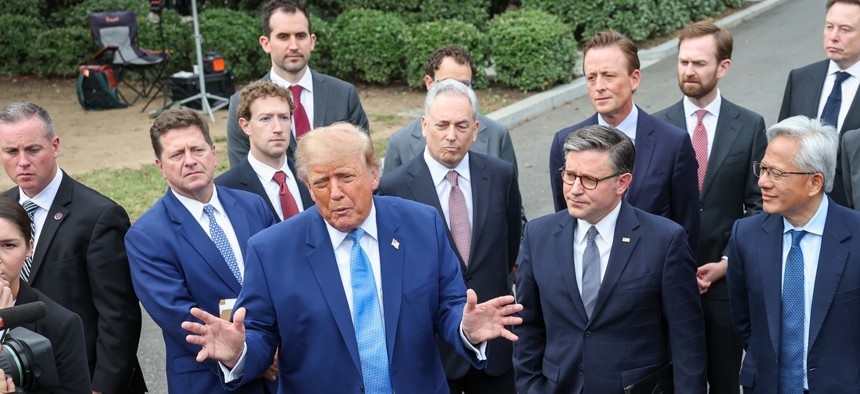
WASHINGTON: President Donald Trump met with top technology executives at the White House on Tuesday to discuss the future of artificial intelligence, concluding the high-level meeting with the signing of a landmark voluntary accord intended to establish industry self-regulation and safety oversight. Officially titled the “White House Accord on Super Intelligence” (or the Joint Commitment on Frontier Responsibilities), the agreement brings together leading figures from Silicon Valley and Washington to navigate the rapid evolution of advanced AI models.
The historic gathering brought prominent tech leaders to the nation’s capital, including Meta CEO Mark Zuckerberg, Google CEO Sundar Pichai, NVIDIA CEO Jensen Huang, Anthropic CEO Dario Amodei, and xAI founder Elon Musk, alongside representatives from OpenAI. During a joint press appearance outside the West Wing following a luncheon, President Trump praised the industry’s commitment to self-policing, describing the framework as “almost like a constitution” for artificial intelligence development. He emphasized that while the agreement remains non-binding, it creates a “morally binding” structure designed to protect against risks while accelerating American leadership in advanced technology.
The newly unveiled accord outlines a four-tier framework focused on internal and external safety evaluations. Under the agreement, participating AI developers commit to establishing independent board committees to oversee risk management, maintaining dedicated internal control teams, and partnering with external auditors to assess safety safeguards. The protocol specifically addresses critical concern areas such as cybersecurity vulnerabilities, biosecurity threats, chemical hazards, and preventing autonomous AI systems from making unauthorized network breaches. Participating firms have also agreed to meet regularly to share best practices and establish standardized safety protocols across the sector.
In addition to safety governance, the discussions focused heavily on the physical infrastructure necessary to maintain AI leadership, notably the rapid construction of energy-intensive data centers across the United States. President Trump reaffirmed his strong support for expanding national data center capacity, arguing that tech companies building these facilities will bring significant economic contributions to local communities. The administration noted that while the voluntary framework relies on industry self-policing for now, future legislation or regulations could eventually codify these practices into law as the technology matures.