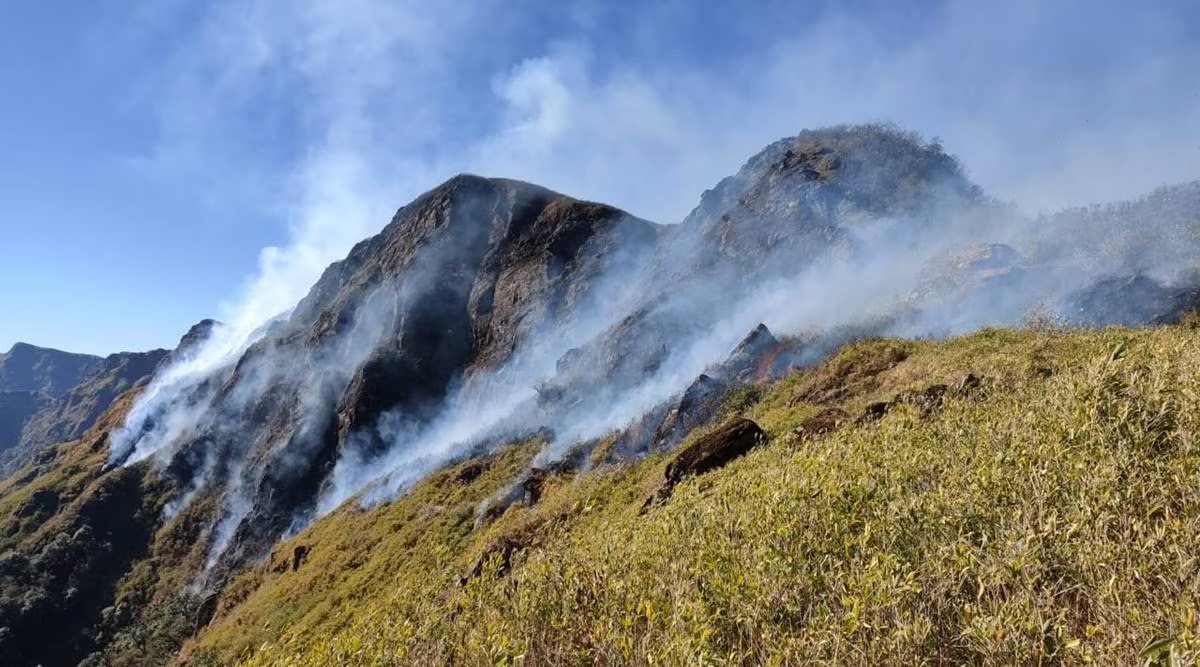
Imphal, Jan 29: A massive forest fire that broke out in the Dziiko Valley has spread to Mt. Esi, the highest peak in Manipur, and has been burning uncontrollably for the past two days, triggering serious concerns over the ecological impact on the biodiversity-rich region.
Volunteers from the Song-song Youth and Students Organisation (SSYSO), along with residents of nearby villages, have been battling the blaze on the ground. However, the intensity and spread of the fire across the rugged mountainous terrain have overwhelmed local efforts. Eyewitnesses said that despite sustained attempts by youth volunteers, the fire continues to advance rapidly.
No formal report has yet been issued by the state government. However, several local leaders have appealed to the Manipur Governor, urging the immediate deployment of specialized teams to help control the blaze.
“The situation is dire. We urgently need government intervention with proper resources and equipment,” said a member of SSYSO. “The fire is far too massive for us to handle with our limited means.”
Environmental activists have warned that failure to contain the fire promptly could cause catastrophic damage to Manipur’s fragile ecosystem and disrupt the ecological balance of the wider region.
This is not the first time the Dziiko Valley–Mt. Esi area has faced such devastation. Between December 2020 and January 2021, a major wildfire destroyed large stretches of vegetation on Mt. Esi, which rises to about 2,994 metres above sea level. Local residents said strong winds at the time had severely hampered firefighting efforts.
The Dziiko Valley, situated along the border of Manipur’s Senapati district and Nagaland’s Kohima district at an altitude of 2,452 metres, is known for its unique biodiversity, including the rare Dzükou lily. The region also serves as a vital ecological corridor in the northeastern Himalayas.
According to official sources, Manipur has emerged as one of India’s most fire-prone states in recent years. In early April 2025, the state recorded 1,424 forest fire incidents within just seven days, ranking third nationwide after Madhya Pradesh and Chhattisgarh. In 2024 alone, Manipur lost approximately 17.8 thousand hectares of natural forest, releasing an estimated 9.11 million metric tonnes of carbon dioxide into the atmosphere.
Earlier data show that between April 1 and April 13, 2020, at least 3,823 hectares of forest were lost to fires in the state, with illegal poppy cultivation identified as a major contributing factor in remote hill districts.
Experts attribute the rising frequency and intensity of forest fires in Manipur to multiple causes. Studies indicate that nearly 90 per cent of forest fires are human-induced, often started by communities living along forest fringes for purposes such as land clearing. Traditional slash-and-burn agriculture, locally known as jhum cultivation, has also contributed to the problem.
Given the difficult terrain and strong winds typical of the Mt. Esi region, ground firefighting operations remain highly challenging. Volunteers on the ground have appealed for the immediate deployment of National Disaster Response Force (NDRF) and State Disaster Response Force (SDRF) teams equipped with specialized firefighting gear. They have also sought aerial support for water-dropping operations.
As the affected area lies along the Manipur–Nagaland border, local communities stressed that coordinated action between authorities of both states would be crucial to controlling the fire. While no casualties have been reported so far, residents warned that if the blaze is not brought under control soon, it could spread further and cause irreparable damage.
Share this:
- Click to share on WhatsApp (Opens in new window) WhatsApp
- Click to share on Facebook (Opens in new window) Facebook
- Click to share on X (Opens in new window) X
- Click to share on LinkedIn (Opens in new window) LinkedIn
- Click to share on Telegram (Opens in new window) Telegram
- Click to print (Opens in new window) Print
- Click to share on Tumblr (Opens in new window) Tumblr