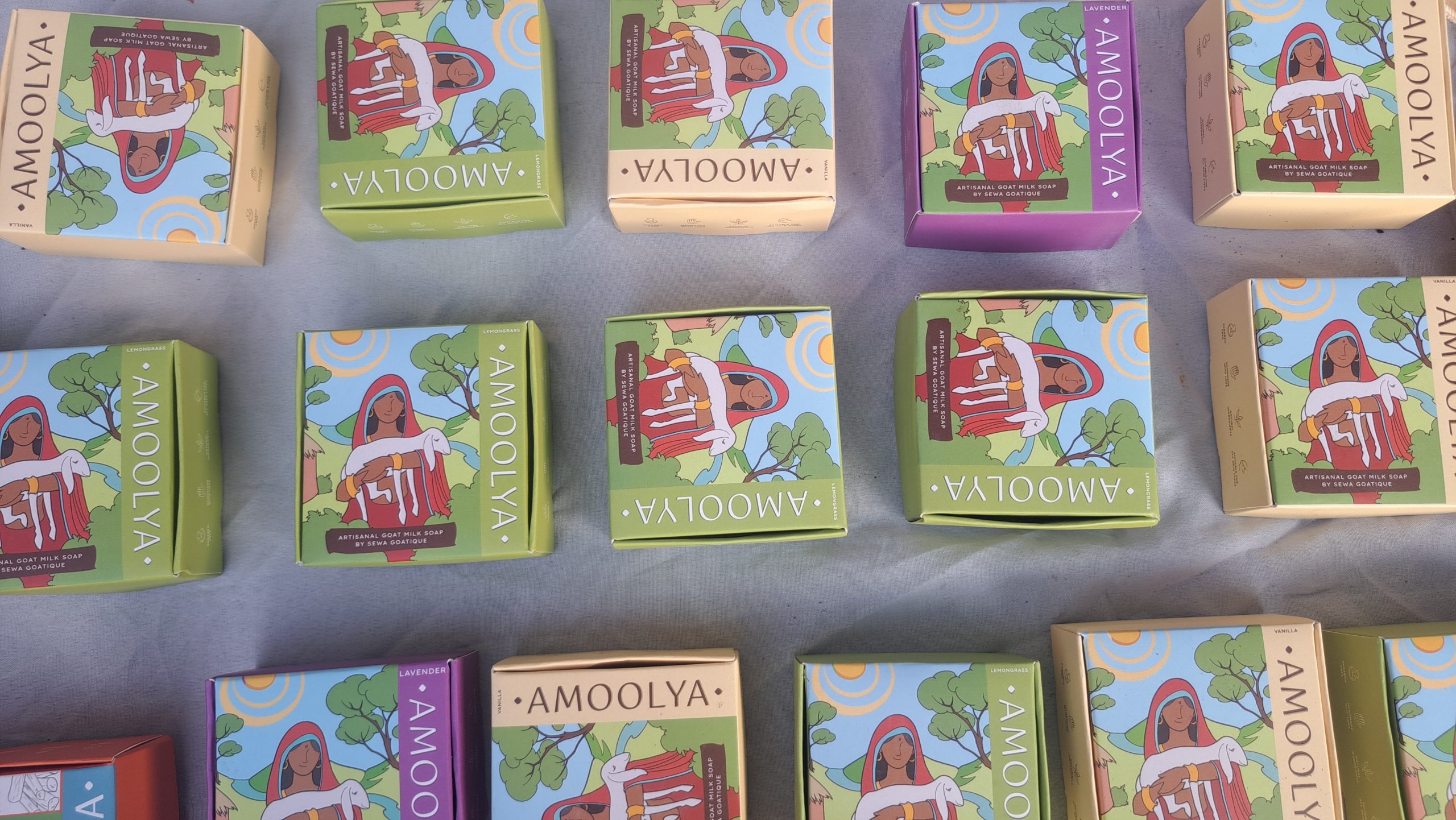
Patna/Munger, Feb 17: Goat milk, once sold as raw milk in village markets, is now being used to make artisanal fragrant soap that promises to be purely herbal and chemical-free. This was made possible in parts of rural Bihar, where a women-led micro-enterprise experimented with goat milk not as a nutrient food but as something that can cleanse the body sans any toxins or chemicals. Their success in the experiment led to self-reliance for a group of women who are now earning well to sustain their families.
Inspired by Mahatma Gandhi’s description of goats as the ‘ATM of the poor,’ women in Patna and Munger districts, about 18 of them, chose an age-old livelihood practice to manufacture herbal goat milk soap, Amoolya, each earning approximately Rs 15,000 per month, an income that is changing the household dynamics and economics.
At the centre of starting this initiative was Sushmita Goswami, Coordinator of Sewa Bharat. “We have been working with goat herders since 2016 for some other projects. Around that time, some women raked up the issue of making soap from goat milk. After that, we began inquiring about the process. Initially, we hurdled through many difficulties. It took us two years before we were able to make soap properly, thanks to the hard work of the women here,” she says.
The journey was a rough ride but the end has been satisfying. “Our experiments led us to fail many times but we also succeeded in some cases. But we did not give up,” Goswami recalls. After nearly two years of trial and error, the group now successfully produces around 4,000 soaps under the banner of Sewa Goatique and is exploring wider markets to sell.
Supervisor of the unit Maya Kumari explains the technical process through which milk gets its soap form. “Fresh goat milk is filtered carefully before being blended with natural oils like coconut and olive. A controlled quantity of sodium hydroxide is added and the mixture is stirred continuously until it thickens. It is then poured into moulds and allowed to set for 24-48 hours,” she says.
But the real transformation happens during curing which takes about three to four-weeks. That curing strengthens and stabilizes the soap. “We make four fragrances of soaps – vanilla, lavender, lemongrass and sandalwood. It takes around 20 to 22 days to prepare a soap,” Maya says.
The emphasis is on herbal techniques and chemical-free production. With an ever growing health-conscious market, salability had to be ensured, she adds.
In Munger, a single bar of soap sells for Rs 60-70. Outside the district, it fetches up to Rs 150. “We are getting the quality checked through various testing processes and searching for a market. When we get a stable market, the price is likely to drop slightly and more people will be able to purchase it,” Goswami states.
For rural enterprises attempting to scale up production and sale, the pricing gap affects their branding potential and market accessibility challenges. “It has affected us as well. But we are hopeful of a solution to all the factors so that women benefit and we give the market a good product,” Goswami adds.
Botany expert Sanjay Kumar underlines the product’s dermatological value. “Goat milk contains lactic acid and various vitamins, which help keep skin soft and healthy. The lactic acid, vitamins A, D and E present in goat milk are beneficial for the skin. The uniqueness of the the product lies in the chemical-free and skin-friendly composition,” he informs.
Natural fats and proteins help moisturize the skin, while mild exfoliating and antibacterial properties make it suitable particularly for sensitive skin types, the botanist adds.
Ashwini, who supports women in Patna through the initiative, speaks about the turning point. “Women were raising goats and their milk was being commercialized. We decided to make soap from goat milk and eventually succeeded. It seemed like a war won,” he narrates.
Goat rearing has, over a period of time, evolved into value-added production. The women are now preparing to expand operations, buoyed by steady demand and growing appreciation from the local people who are using the product.
Rajesh Thakur, a volunteer from the Tarapur area, agrees that the community impact of the product is high. “The women’s efforts are commendable. Local people are buying the soap and sharing its benefits after using it. We have also used it. The soap is excellent and provides relief from various skin problems,” he affirms.
Share this:
- Click to share on WhatsApp (Opens in new window) WhatsApp
- Click to share on Facebook (Opens in new window) Facebook
- Click to share on X (Opens in new window) X
- Click to share on LinkedIn (Opens in new window) LinkedIn
- Click to share on Telegram (Opens in new window) Telegram
- Click to print (Opens in new window) Print
- Click to share on Tumblr (Opens in new window) Tumblr