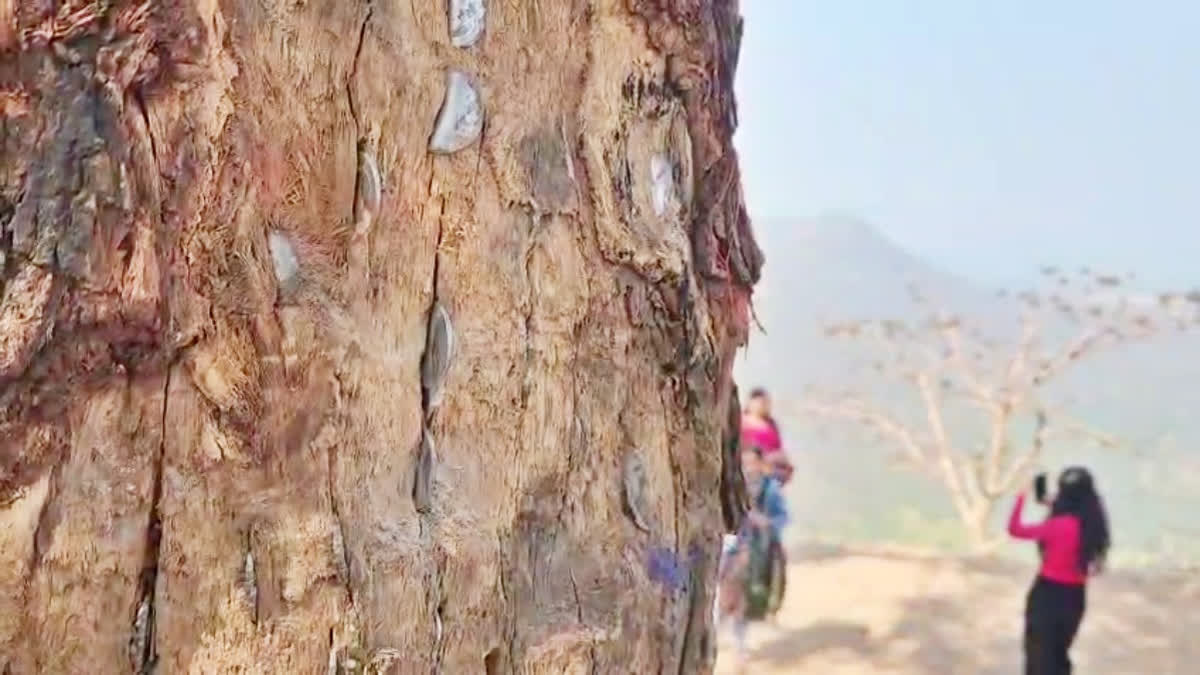
Nalanda, Feb 22: People visiting the iconic Vishwa Shanti Stupa atop Ratnagiri Hills have been inserting coins into Baheda trees with a belief that their wishes will be fulfilled. Not many know that such a belief has taken a toll on the Baheda tree, which has has dried and dead. Popularly known as the ‘Tree of Coins,’ the coin-filled trunks have become a tourist attraction but not without raising environmental concerns.
Located close to the Japanese Buddhist Temple in Rajgir, Nalanda district, the tree draws devotees from far and near, who after offering prayers at the stupa, literally hammer one, two, five and ten-rupee coins into its bark praying for wish fulfilment. As a result, over the years, the practice has intensified to the point where the trunk appears almost plated with metal every inch. At sunrise and sunset, the embedded coins reflect golden light and create a shimmering spectacle. Many visitors, particularly couples, go to the place to have a look at the coin tree.
Security personnel deployed in the area confirm the trend. “Tourists from countries like Bhutan and Korea also come here. They make wishes and stick coins into the tree to fulfil them. There are varied denominations of coins, no strictness on the amount or value. But we see the tree getting harmed in the process. People should not stick coins. Mostly couples in love do it,” said Lallu Prasad, a guard stationed on Ratnagiri Hills.
Environmentalists, however, warn that the practice has affected the tree biologically. According to Umakant Singh, Head of the Geography Department at Baldev PG College, Varanasi and an environmentalist, embedding coins punctures vascular tissues responsible for transporting water and nutrients.
“Inserting coins into the trunk destroys the tree’s glands, blocking the upward flow of water from the roots. As a result, these rare medicinal trees are slowly dying. This is a bad practice causing irreparable environmental damage,” he said, warning that the government must take action to stop this practice before it gets too late.
Ratnagiri Hills form part of the northern fringe of the Chota Nagpur Plateau, a geomorphologically sensitive zone already experiencing erosion. Trees act as natural soil binders. If weakened or killed, slope instability could cause problems thus increasing the risk of land degradation.
Students accompanying Dr. Singh also demanded installation of railings and stricter regulation of tourist movement to prevent further harm. “It is time the an immediate conservation plan is taken up and and plantation drives encouraged,” they said
Though the glitter of the tree continues to shine, blind faith is certainly marking the gradual decline of Rajgir’s fragile green cover.