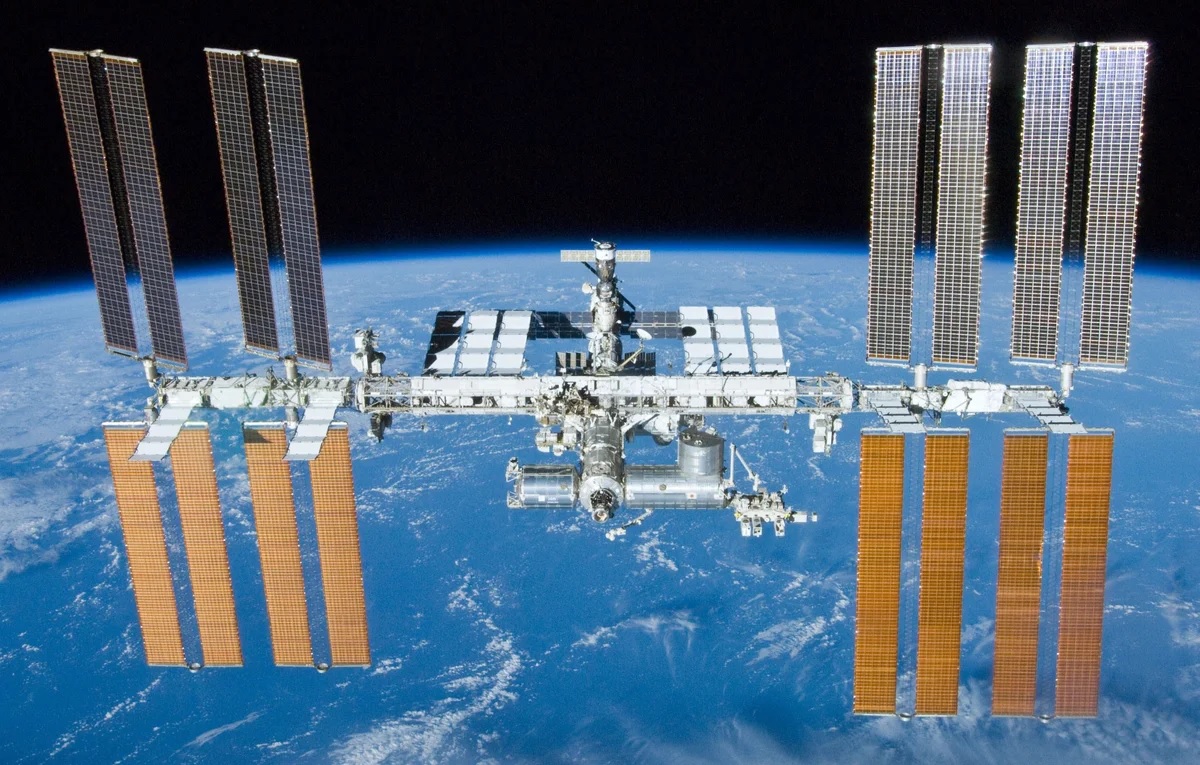
For over a quarter of a century, there has not been a moment when all humans were together on planet Earth, and that’s thanks to the International Space Station (ISS), traveling over 400 kilometers above Earth. This spacelab has been a symbol of cooperation, a place for advanced scientific investigations, and a home for long-duration forays into space. In five years, it will come crashing through the atmosphere in a controlled deorbit as it comes to an end. If we could save it, should we? Two lawmakers think that NASA should at the very least consider it.
The NASA Reauthorization Act of 2026 was unanimously approved by the House Science Committee on February 4, after dozens of amendments were added. The act is not a budget (which was approved separately), but it sets the priorities, goals, and funding targets for the space agency. The bill now moves to the House of Representatives to be voted on before moving to the Senate, and eventually, if approved, signed into law by the President.
There were 40 different amendments attached to this bill, including strengthening the Deep Space Network to support NASA centers, including the Goddard Space Flight Center. Just a few months ago, a Space.com investigation revealed that some of the Trump administration’s proposed 2026 budget cuts to Goddard may have already been implemented prematurely, and possibly illegally, during last year’s government shutdown.
However, the amendment we are interested in specifically here is this: Representative George Whitesides (D-Calif.), with the co-sponsorship from Rep. Nick Begich (R-Alaska), submitted Amendment 36 that requires NASA to investigate if it’s possible to not crash the ISS into the ocean when it comes to an end, as scheduled in 2031, but whether it could be moved and stored in a higher and safer “orbital harbour”.
Hypothetically, if it could be moved to a less risky orbit and if the last crew left it in the state it was in when they were using it, it would be an absolute dream as an archaeological site.
Why And How Will The ISS End?
The ISS is old. It has been maintained and upgraded over its 27 years, but it is showing its age. The Russian section, in particular, has dealt with cracks and leaks. It would need major upgrades to continue operations, and those would be costly. NASA is, for these reasons, looking at private enterprise, such as the Axiom Station, to continue its operation in low-Earth orbit. The ISS mission has been extended through 2030, but the plan is that it will be retired the following year.
The spacecraft is located at an altitude of about 410 kilometers (255 miles) from the ground. The atmosphere is extremely thin there, but over time, this tenuous drag slows the space station down. Slowing down moves it to a lower orbit, and lower orbits decay faster. For this reason, the space station will have to be guided back down to Earth, where it will be dropped into Point Nemo in the South Pacific Ocean. Point Nemo is the furthest spot from land on planet Earth, with the nearest land being around 2,700 kilometers (1,678 miles) away, and has become famous as the place where spacecraft go to die.
If it weren’t guided down, it would come back down on its own in an uncontrolled reentry, and we most definitely don’t want that. The ISS is big! Its truss length measures 109 meters (357.6 feet), and its mass is 419,725 kilograms (925,335 pounds). A fair amount of it will burn up on reentry, but we know that bits of it can survive the process (and you do not want it to fall through your house).
The amendment has asked NASA to look at the feasibility and the costs of moving the ISS to a higher orbit to potentially preserve it for future reuse.
“The end is in sight. This amendment directs NASA to conduct a study on whether it would be feasible to safely move the station, following its retirement in just a few short years, to a higher stable orbital storage location,” Rep Whitesides said.
“At a time when we are thinking seriously about sustainability in space, this amendment protects taxpayer investment and ensures that we fully understand our options before an irreplaceable asset is permanently retired.”
What If The ISS Is Saved?
We don’t want to be pessimistic, but it is unlikely that the study would show that it is feasible. The regular uplifting of the ISS is done by turning on the thrusters of a docked spacecraft, currently either a Soyuz capsule or SpaceX’s Crew Dragon. These crafts usually move the ISS by a handful of kilometers. Moving to a higher orbit would be a much longer trek, with demanding fuel requirements and connected costs.
Still, if it were to happen, of course we’d be overjoyed. Beyond the actual cost, the ISS is such an important artifact of the space age that it would be an enormous pity if it were to just burn up in the atmosphere. And not just for sentimental reasons, there are scientific reasons, too.
“Hypothetically, if it could be moved to a less risky orbit and if the last crew left it in the state it was in when they were using it, it would be an absolute dream as an archaeological site,” Professor Alice Gorman, from Flinders University, told IFLScience.
Professor Gorman is a space archaeologist and has already conducted remote archaeological research on the ISS. It might seem peculiar to do archaeology on something so modern, something you could just interview people about and get data logs for, but applying archaeological techniques to the ISS reveals insights into behaviors that not even the people involved in building or living on the station are aware of and can articulate.
The minute a place is abandoned, it starts to deteriorate. This will happen to the ISS if it’s not being maintained continuously. So if you want a good heritage outcome, if you want to make sure a place survives, it should be used and occupied.
So, what could we study if we turned the ISS into an archaeological site? “We could look at the layers of occupation because the inside is a horrible mess,” Professor Gorman told IFLScience with a smile.
“The reason it’s a horrible mess is that stuff from the first occupation, all the bloody leads and wires and everything, is kind of tangled up with the latest stuff. So you would untangle that, and you would work out the thing that we’re interested in as archaeologists, not what people thought happened or what the document said happened, but what really happened. We could answer so many questions about human behavior in a space station in microgravity.”
Those insights could help us build better space stations, more human-friendly ones. The space station could be left to its own devices, and we would see the effects of space weather, micrometeoroids, and space junk on it. How quickly would it fall apart without human intervention? That would be very useful information for the future of space exploration.
If it were to become a heritage site instead, Professor Gorman argues that it needs to be one that is lived in. With all kinds of tourists, not just billionaires, having the possibility to visit it.
“The minute a place is abandoned, it starts to deteriorate. This will happen to the ISS if it’s not being maintained continuously. So, if you want a good heritage outcome, if you want to make sure a place survives, it should be used and occupied,” Professor Gorman told IFLScience.
Professor Gorman does not think that this is going to actually happen, however, but let’s stay with the hypothetical for a little while longer. Maybe it’s 2050, and you are visiting a private space station. That space station is a tourist hotel, spacious and full of amenities, though its crown jewel is what is attached to it: the old International Space Station is still there. A space museum, if you will – the world’s first.
“Look at how cramped it was back there, how messy, and yes its smells a bit. They didn’t have the air scrubbers we have today,” the guide tells you. “Although it seems quaint now, by its 25th year, it had hosted over 250 people from 26 countries, conducting several thousand scientific investigations on behalf of researchers from over 100 countries. It was an enormous effort on behalf of all humankind. And we almost risked losing it forever!”
Share this:
- Click to share on WhatsApp (Opens in new window) WhatsApp
- Click to share on Facebook (Opens in new window) Facebook
- Click to share on X (Opens in new window) X
- Click to share on LinkedIn (Opens in new window) LinkedIn
- Click to share on Telegram (Opens in new window) Telegram
- Click to print (Opens in new window) Print
- Click to share on Tumblr (Opens in new window) Tumblr