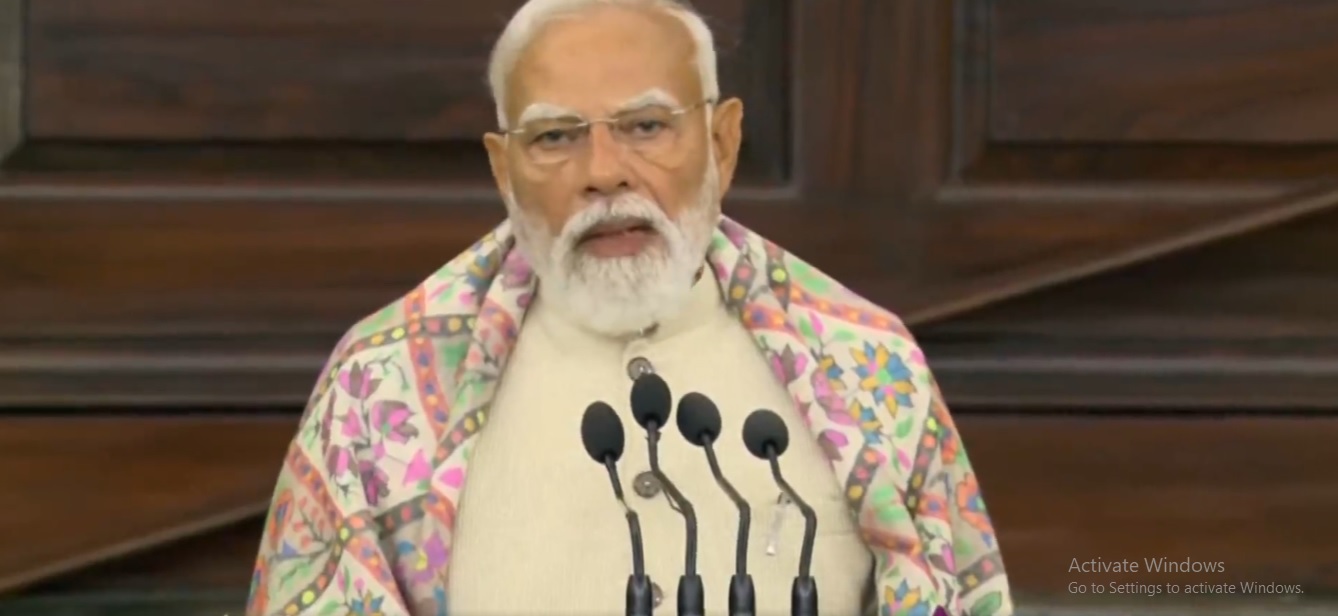
New Delhi, Jan 15: Prime Minister Narendra Modi on Thursday projected India’s parliamentary democracy as a model that combines diversity with development, asserting that “in India, democracy delivers.”
Inaugurating the 28th Conference of Speakers and Presiding Officers of the Commonwealth (CSPOC) in the Central Hall of the Samvidhan Sadan in Parliament House Complex, the Prime Minister underscored the unique and demanding role of the Speaker in a parliamentary democracy.
“The Speaker does not get to speak much. Their responsibility is to listen, to ensure that everyone gets a chance to express themselves,” he said, adding that patience defines the office. “Even in the face of noise or over-enthusiasm, Speakers handle situations with a smile,” he remarked.
Welcoming the delegates, the Prime Minister said the venue itself symbolised India’s democratic journey. He recalled that the Central Hall had hosted the Constituent Assembly in the final years of colonial rule, where India’s Constitution was drafted.
“For 75 years after Independence, this building served as India’s Parliament, where decisions shaping the nation’s destiny were taken,” PM Modi said, noting that it has now been dedicated to democracy as the Samvidhan Sadan. The presence of global parliamentary leaders here, he said, marked “a very special moment for India’s democracy,” especially as the country recently celebrated 75 years of the Constitution’s implementation.
This is the fourth time India is hosting the CSPOC. Highlighting the conference theme—Effective Delivery of Parliamentary Democracy—PM Modi addressed long-standing doubts that once surrounded India’s democratic experiment.
“When India became independent, many feared democracy would not survive in such a diverse society. India turned this diversity into the strength of its democracy,” he said. Another concern, he added, was that development would be incompatible with democracy. “India has proved that democratic institutions and democratic processes provide stability, speed and scale.”
Citing India’s economic and technological progress, the Prime Minister said the country is today the world’s fastest-growing major economy and home to the largest digital payments ecosystem through UPI. He listed achievements ranging from India being the largest vaccine and milk producer to hosting the third-largest startup ecosystem and aviation market, and the fourth-largest railway network globally.
“In India, democracy means last-mile delivery,” PM Modi emphasised, noting that public welfare without discrimination is central to governance. “Because of this spirit, about 25 crore people have come out of poverty in recent years. In India, democracy delivers,” he asserted.
The Prime Minister said democracy works in India because people are supreme and their aspirations drive governance. Processes and technology, he said, have been democratised to remove obstacles.
Recalling the COVID-19 pandemic, PM Modi said India not only tackled internal challenges but also supplied medicines and vaccines to more than 150 countries. “Serving people’s interests, welfare and well-being is India’s ethos, nurtured by its democracy,” he said.
Highlighting the scale of Indian democracy, PM Modi referred to the 2024 general elections as “the largest democratic exercise in human history,” with nearly 980 million registered voters, over 8,000 candidates and more than 700 political parties. He also pointed to record participation by women voters and leaders. “Today, Indian women are not just participating, they are leading,” he said, noting that India has a woman President and that Delhi, where the conference is being held, is led by a woman Chief Minister. At the grassroots level, he added, about .5 million women representatives form nearly half of local government leadership—“a global rarity.”
Describing India as the “Mother of Democracy,” PM Modi traced democratic traditions back thousands of years, from deliberative assemblies mentioned in the Vedas to Buddhist Sanghas and a 10th-century Tamil Nadu inscription detailing village assemblies with accountability norms. “India’s democratic values have been tested by time, supported by diversity and strengthened generation after generation,” he said.
The Prime Minister noted that nearly half of the Commonwealth’s population resides in India and said the country remains committed to shared development goals, including health, climate action, economic growth and innovation. He reiterated India’s role in amplifying the voice of the Global South, recalling that during its G20 Presidency, India placed Global South concerns at the centre of the global agenda. “This is a moment for the Global South to chart new pathways,” PM Modi said, adding that India is building open-source digital platforms that partner nations can adapt.
On parliamentary innovation, PM Modi highlighted India’s efforts to bring citizens closer to democratic processes through study tours, training programmes and internships. He said artificial intelligence is now being used to translate parliamentary debates in real time into regional languages and to make parliamentary resources more accessible, especially for younger generations.
Wrapping up his address, PM Modi said his interactions with parliaments across more than 20 Commonwealth countries had been a learning experience. “Every best practice I come across is shared with the Speaker of the Lok Sabha and the leadership of the Rajya Sabha,” he said, expressing confidence that the conference would further strengthen collaboration.
Lok Sabha Speaker Om Birla, Rajya Sabha Deputy Chairman Harivansh, Inter-Parliamentary union President Dr Tulia Ackson and Commonwealth Parliamentary Association Chairperson Dr Christopher Kalila were among the dignitaries present. The 28th CSPOC, chaired by Om Birla, is being attended by 61 Speakers and Presiding Officers from 42 Commonwealth countries and four semi-autonomous parliaments.
The conference will deliberate on issues like the role of Speakers in safeguarding democratic institutions, the use of artificial intelligence in parliamentary functioning, the impact of social media on legislators, and innovative ways to enhance citizen engagement beyond voting.