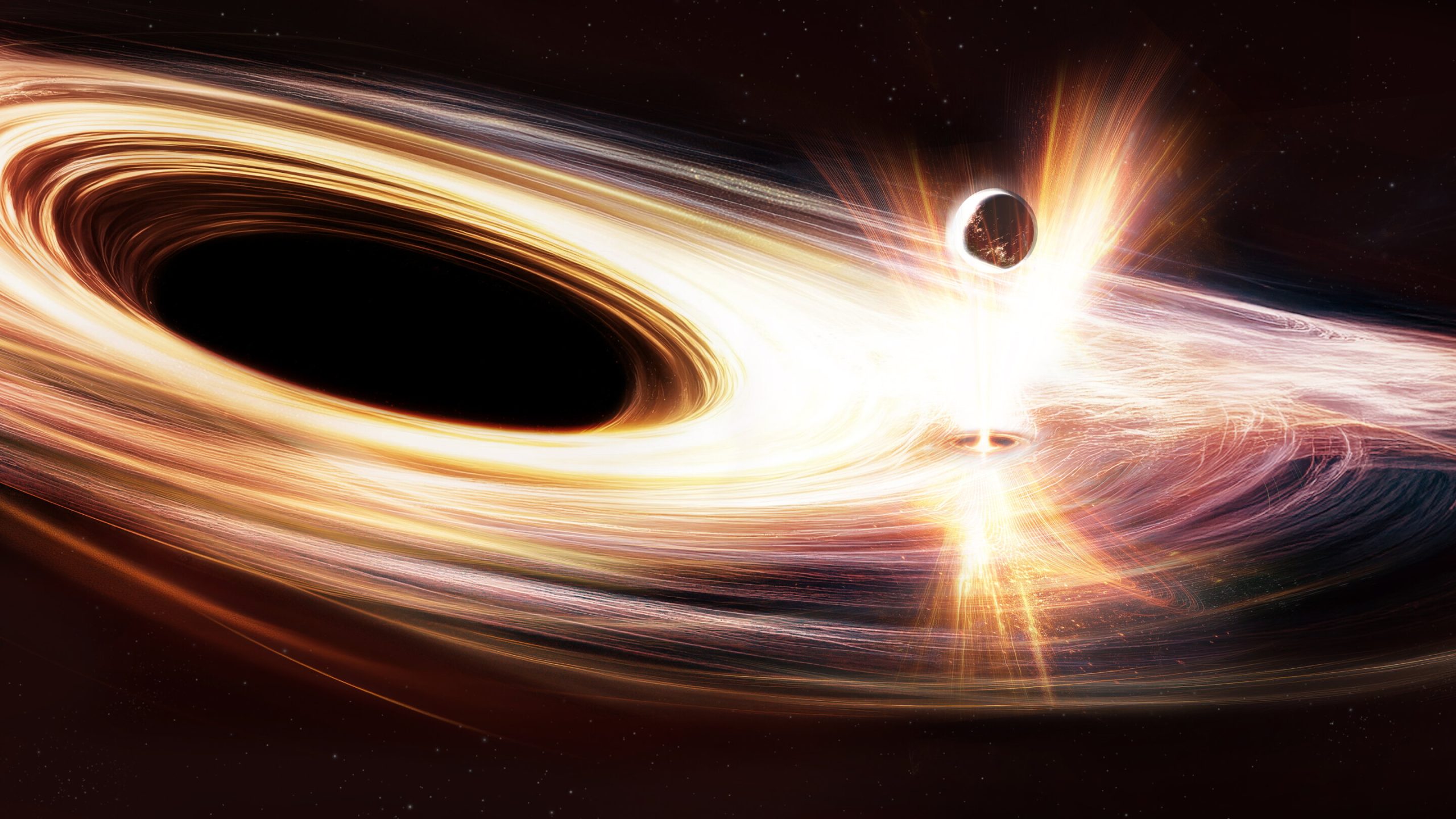
Astronomers have captured the moment a ‘reborn’ supermassive black hole awakened after 100 million years of silence.
Incredible images show the black hole erupting like a ‘cosmic volcano’, with enough force to reshape its entire host galaxy.
While almost all galaxies host a monstrous supermassive black hole at their heart, few produce such spectacular explosions of superheated plasma.
Spanning almost one million light–years, these plumes of cosmic lava are nearly 10 times wider than the Milky Way.
Lead researcher Dr Shobha Kumari, of Midnapore City College in India, says: ‘It’s like watching a cosmic volcano erupt again after ages of calm.’
The researchers say their radio images aren’t just impressive to look at, but also reveal the hidden violence of the ‘messy, chaotic struggle’ at the galaxy’s core.
The black hole, dubbed J1007+3540, lives inside an enormous galaxy cluster filled with extremely hot gas.
This creates a constant battle between the explosive power of the black hole and the crushing pressure of the surrounding galaxy.
Scientists have captured the moment a supermassive black hole roared back to life after 100 million years of silence, erupting like a ‘cosmic volcano’
Supermassive black holes are the ultra–dense cores of dead stars that collapsed in supernova explosions, with masses up to 10 million times larger than that of the sun.
Their gravitational pull is so strong that not even light can escape beyond the point of no return known as the ‘event horizon’.
Typically, the supermassive black holes at the centre of most galaxies are relatively stable, with the surrounding matter orbiting at a safe distance.
However, these monstrous objects can sometimes start to feed on the surrounding clouds of gas that fill the galactic core and become ‘active’.
As matter swirls inwards towards the event horizon like water circling a drain, it starts to move incredibly quickly, and friction heats it to enormous temperatures.
Eventually, these forces become so powerful that the black hole starts shooting a jet of superheated plasma into space that produces a blast of electromagnetic radiation.
This ejects a huge amount of the matter falling into the black hole, which is why astronomers sometimes call black holes ‘messy eaters’.
In their new paper, published in Monthly Notices of the Royal Astronomical Society, scientists used the Low Frequency Array (LOFAR) in the Netherlands and India’s upgraded Giant Metrewave Radio Telescope (uGMRT) to look for radio emissions from J1007+3540.
The supermassive black hole, dubbed J1007+3540, has now become active, shooting a jet of plasma almost 10 times wider than the Milky Way out into space (illustrated)
Why do black holes ‘erupt’?
Most supermassive black holes are considered ‘dormant’, which means they aren’t actively feeding on matter.
However, when a black hole starts to feed on matter, it becomes ‘active’ and begins to produce radiation.
This is because matter swirling around the black hole is superheated to the point that it is shot out in a jet.
This plasma produces large amounts of X–rays and radio radiation that can be detected from Earth as an eruption.
These images showed a compact, bright inner jet of radio–emitting magnetised plasma that is the telltale sign of the black hole’s recent awakening.
The researchers also discovered just how profoundly the intense pressures at the heart of the galaxy cluster were shaping the black hole.
As the jets are pushed outwards, they are bent, squeezed and distorted by their extreme environment.
As their radio images show, the topmost ‘northern lobe’ of the jet has been compressed into a curve that seems to have been shoved sideways by the gases.
However, the astronomer’s observations didn’t just reveal the secrets of this black hole’s current eruption.
Just like the volcanoes here on Earth, J1007+3540 has a long and violent history of eruptions.
Just outside the bright inner jet, astronomers spotted a cocoon of older, faded plasma.
This is the leftover debris from past eruptions that has been squeezed and distorted by the hostile environment.
Uniquely, the researchers discovered the remains of previous ‘eruptions’ surrounding the active black hole (artist’s impression). This suggests that this cosmic volcano has erupted multiple times in the past
Dr Kumari says: ‘This dramatic layering of young jets inside older, exhausted lobes is the signature of an episodic AGN [Active Galactic Nucleus] – a galaxy whose central engine keeps turning on and off over cosmic timescales.’
In our own galaxy, the supermassive black hole at the galactic core is currently dormant.
However, scientists do believe that the black hole, known as Sagittarius A*, could make a similar eruption.
If this were to happen, Sagittarius A* would produce its own jets or plasma that could fundamentally reshape the universe.
While Earth would likely be protected from any radiation, a direct hit from one of those jets would be strong enough to wipe out life on Earth.
But there’s no need to worry as scientists think this won’t happen until the Milky Way collides with our neighbouring galaxy, the Large Magellanic Cloud (LMC), in 2.4 billion years.
Black holes are so dense and their gravitational pull is so strong that no form of radiation can escape them – not even light.
They act as intense sources of gravity which hoover up dust and gas around them. Their intense gravitational pull is thought to be what stars in galaxies orbit around.
How they are formed is still poorly understood. Astronomers believe they may form when a large cloud of gas up to 100,000 times bigger than the sun, collapses into a black hole.
Many of these black hole seeds then merge to form much larger supermassive black holes, which are found at the centre of every known massive galaxy.
Alternatively, a supermassive black hole seed could come from a giant star, about 100 times the sun’s mass, that ultimately forms into a black hole after it runs out of fuel and collapses.
When these giant stars die, they also go ‘supernova’, a huge explosion that expels the matter from the outer layers of the star into deep space.
Share this:
- Click to share on WhatsApp (Opens in new window) WhatsApp
- Click to share on Facebook (Opens in new window) Facebook
- Click to share on X (Opens in new window) X
- Click to share on LinkedIn (Opens in new window) LinkedIn
- Click to share on Telegram (Opens in new window) Telegram
- Click to print (Opens in new window) Print
- Click to share on Tumblr (Opens in new window) Tumblr