Chennai, Feb 25: The most telling moment of this ICC Men’s T20 World Cup did not come from a bat swing or a yorker. It came quietly on an AI-driven probability dashboard.
Before a ball was bowled, multi-agent AI systems had already modelled outcomes, player fatigue curves, pitch wear, and matchups. By the time India walked out to face South Africa in the Super 8, algorithms had already simulated that game thousands of times.
And sitting in the stands that evening was Sundar Pichai — a spectator, yes, but also a symbol. The tech world is no longer watching cricket. It is shaping it. The transition from cricket gaming to real cricket infrastructure is no longer theoretical. It is the defining narrative of the T20 Men’s World Cup, 2026.
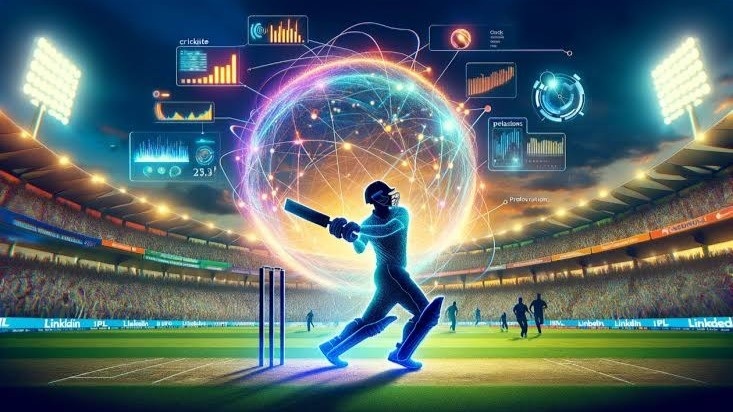
At the India AI Impact Summit 2026 in New Delhi, visitors queued up not for autographs but to face an AI bowler at Google’s pavilion. The system tracked bat speed, footwork alignment, head position and timing — delivering instant coaching cues through computer vision.
It is no gimmick. It is a prototype of the future net session.
Google’s AI coach now functions as a real-time biomechanical analyst — a digital batting coach capable of diagnosing flaws in milliseconds. It is the same technology now being adapted for elite teams.
Meanwhile, Chennai-based technology solutions firm NVIDIA’s footprint is even deeper. The company is working with Indian firms to build gigawatt-scale AI data centres in Chennai and Mumbai — infrastructure designed to process the flood of data that modern cricket generates: Ball trajectories, joint stress, micro-movements and fatigue markers. These are not mere upgrades; they are a new sporting nervous system.
Fans Analysts
The fan experience has been quietly revolutionised, too. Through Google’s Gemini integration with ICC platforms, fans can now access Insight Cards — instant breakdowns of matchups, rule clarifications, player tendencies and even scenario simulations. For decades, cricket was explained by commentators. Now, it is being explained by machines. The boundary between spectator and analyst has collapsed. Every fan can now carry a data lab in his or her pocket for instant, in-depth and accurate analyses.
Gaming Retreat And Reinvention
Ironically, while AI giants have stepped onto the cricket pitch, traditional cricket gaming companies have moved away from real-money models to entertainment ecosystems powered by the same AI.
Platforms like Hitwicket, for example, now offer AI-personalised commentary, adapting tone and context based on how a user plays. Dream Sports has pivoted toward social cricket gaming experiences where multiplayer matches are enhanced by generative AI narration and predictive strategy engines.
The direction is clear: Gaming is becoming more like real cricket, while real cricket is becoming more like a simulation engine. The two worlds have merged.
Invisible Third Umpire
Perhaps the most profound shift is the quietest one. AI has become cricket’s most consistent decision-maker. From Hawk-Eye projections for LBWs to UltraEdge’s edge detection, modern officiating is now a real-time computational exercise. Cameras, sensors, and AI-driven video processing deliver decisions in seconds — often with greater precision than the human eye. Disputes have not disappeared. But uncertainty has.
Body as Data
The modern cricketer is a dataset first and an athlete later. Wearable sensors embedded in jerseys and straps track muscle load, hydration, acceleration and recovery. AI models flag injury risks before the player can feel discomfort.
For a format as relentless as T20, where tournaments compress high-intensity cricket into a few weeks, this is transformative. Coaches now rotate bowlers not by instinct, but by predictive fatigue models. Workload management is no longer reactive — it is pre-emptive.
Strategy Simulation
Match strategy, once the art of gut instinct and dressing-room feel, is now being augmented by simulation engines like CricViz. Captains enter games with scenario trees — knowing the success rate of bowling a slower ball on a dry pitch in the 17th over against a left-hander with a strike rate of 142 against pace.
Field placements are no longer only visualised — they are probability-mapped. And yet, cricket’s romance remains. Because even the most advanced model cannot predict a mistimed pull sailing over fine leg for six.
Predicting The Unpredictable
The AI prediction models for this World Cup have already become a talking point. India’s 87% winning probability against Zimbabwe appears comfortable. But the 24% probability against West Indies has added a layer of drama — numbers now framing narratives before matches begin.
This is the paradox of AI in cricket: It quantifies uncertainty but cannot eliminate it. Upsets still happen. Miracles still occur. The difference is that now, we know exactly how unlikely they were.
New Cricket Ecosystem
What we are witnessing is not just technological adoption. It is a structural transformation of cricket’s ecosystem. Consider this: ChatGpt is the official sponsor of the ongoing World Cup. AI companies are now infrastructure partners; data has become a performance asset; fans are active analysts and coaching is hybrid human-machine collaboration
And perhaps most significantly — the sport’s economic architecture is shifting too. Where gaming once monetised cricket, AI now enhances its core product: The match itself.
Future Already Here
If this World Cup has shown anything, it is that cricket’s future is no longer coming. It has arrived. The nets are smarter. The stadiums are smarter. The fans are smarter. So, decisions should also be sharper. Perhaps, AI was not consulted before dropping Axar Patel.
In the middle of all this intelligence, the game still hinges on a simple duel — bat versus ball. The algorithms can predict. They can advise. They can simulate. But they cannot feel pressure. They cannot improvise instinctively. They cannot replace the human heartbeat that defines sport.
Which is why, even in this age of AI factories and machine learning models, the most beautiful thing about cricket remains unchanged. You still have to middle the ball!