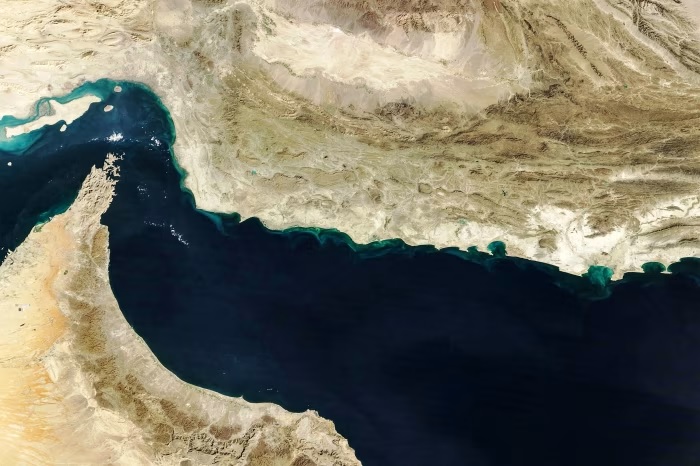
Tehran: In what could be an initial sign of easing pressure on global shipping, a new route appears to have opened in the Strait of Hormuz for commercial vessels, which avoids the normal path as well as the one established by Iran recently.
AIS (Automatic Identification System) and remote sensing data analysed by NDTV Datafy show that at least four large vessels carrying oil, LNG and general cargo have passed through the new route that avoids international waters and stays within Oman’s territorial sea limits.
Two Very Large Crude Carriers (VLCCs) – the Marshall Islands-flagged Habrut and Dhalkut – as well as the Panama-flagged Sohar LNG carrier entered Oman’s territorial waters near the Emirati city of Ras Al Khaimah and turned off their position-emitting signal transponders near the Musandam Peninsula. On April 3, they were spotted 350 km off the coast of Muscat.
Dhalkut and Habrut were laden with 20 lakh barrels of Saudi and Emirati crude, respectively, according to maritime analysis firm TankerTrackers. Sohar departed the UAE port of Al Hamriyah on March 21, but it was unclear if it was carrying any load. It’s AIS status was listed as partially laden.
Following the three ships was an Indian-flagged cargo carrier, whose AIS signals identified it as MSV Quba MNV 2183. It set sail from Dubai on March 31 and showed its latest position in the open seas nearly 40 kms from the port of Dibba, Oman. It’s not clear whether the ship was laden or where it is headed.
Disruption And Iran’s ‘Toll Booth’
Iran began attacking ships with missiles and drones days after the US and Israel launched coordinated airstrikes on the Islamic nation on February 28. Nearly one-fifth of global energy supplies flows through the strait. and energy supplies to many countries, including India, have been disrupted by the blockade.
Two Very Large Crude Carriers (VLCCs) – the Marshall Islands-flagged Habrut and Dhalkut – as well as the Panama-flagged Sohar LNG carrier entered Oman’s territorial waters near the Emirati city of Ras Al Khaimah and turned off their position-emitting signal transponders near the Musandam Peninsula. On April 3, they were spotted 350 km off the coast of Muscat.
Dhalkut and Habrut were laden with 20 lakh barrels of Saudi and Emirati crude, respectively, according to maritime analysis firm TankerTrackers. Sohar departed the UAE port of Al Hamriyah on March 21, but it was unclear if it was carrying any load. It’s AIS status was listed as partially laden.
Following the three ships was an Indian-flagged cargo carrier, whose AIS signals identified it as MSV Quba MNV 2183. It set sail from Dubai on March 31 and showed its latest position in the open seas nearly 40 kms from the port of Dibba, Oman. It’s not clear whether the ship was laden or where it is headed.
Disruption And Iran’s ‘Toll Booth’
Iran began attacking ships with missiles and drones days after the US and Israel launched coordinated airstrikes on the Islamic nation on February 28. Nearly one-fifth of global energy supplies flows through the strait. and energy supplies to many countries, including India, have been disrupted by the blockade.
Since then, Tehran has established a new, longer shipping route to control vessel movement in the waterway. This route goes through Iran’s territorial waters and a narrow passage between the islands of Qeshm and Larak. As per reports, the IRGC grants permission to vessels on a case-by-case basis and visually verifies ships’ identities from its naval bases on the two islands. Tehran, reports said, imposes a toll of $1 per barrel of crude that a ship carries.
The passage of these vessels coincides with large fires at IRGC’s primary naval base at Qeshm, which analysts believe was caused by airstrikes on at least four warehouses at the facility.
Share this:
- Click to share on WhatsApp (Opens in new window) WhatsApp
- Click to share on Facebook (Opens in new window) Facebook
- Click to share on X (Opens in new window) X
- Click to share on LinkedIn (Opens in new window) LinkedIn
- Click to share on Telegram (Opens in new window) Telegram
- Click to print (Opens in new window) Print
- Click to share on Tumblr (Opens in new window) Tumblr