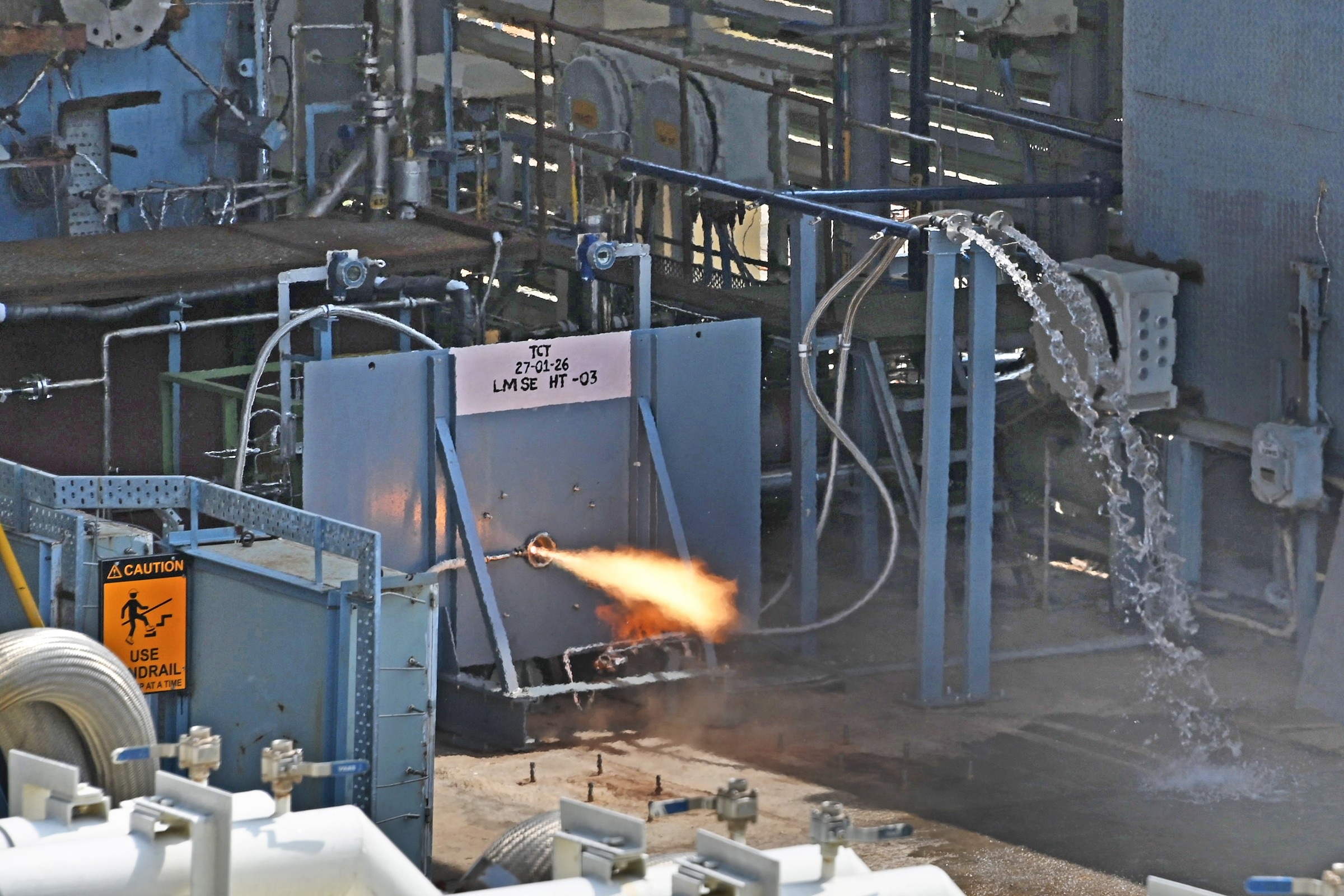
Chennai, Feb 1: The Indian Space Research Organisation (ISRO) has successfully conducted the first hot test of its high-thrust LOX–Methane engine at the thrust chamber level, marking a significant milestone in the development of India’s Next Generation Launch Vehicle (NGLV), internally known as Soorya.
The test was carried out at the Thrust Chamber Test Facility of the ISRO Propulsion Complex (IPRC).
According to ISRO, the sub-scale thrust chamber equipped with a single-element injector was successfully tested up to a chamber pressure of 56 bar.
“The sub-scale thrust chamber and single-element injector head were realised through the additive manufacturing route. Ignition and sustained combustion inside the thrust chamber were achieved, and the performance of all systems was found to be normal,” ISRO said in a statement.
ISRO is developing the LOX–Methane engine for induction into its next generation of launch vehicles, with subsystem development progressing at the Liquid Propulsion Systems Centre (LPSC). Testing of these engine subsystems at the sub-scale level has now begun.
Highlighting the importance of the milestone, ISRO noted that an optimally designed thrust chamber and injector head are critical to the success of any cryogenic engine, and the latest test represents the first successful hot test of a high-thrust LOX–Methane engine at the thrust chamber level.
Former ISRO Chairman and Secretary, Department of Space, Dr S. Somanath, said the NGLV was conceived as a reusable, modular launch vehicle with a significantly higher payload capacity.
Unlike earlier designs, the vehicle will be powered entirely by liquid propulsion systems, requiring larger, more advanced engines with throttling capability.
The three-stage NGLV will feature clustered LOX–Methane engines in its first two stages, while the third stage will use a cryogenic engine. In its full configuration, the vehicle is expected to have a lift-off mass of approximately 1,000 tonnes.
The NGLV project is being developed at an estimated cost of ₹8,240 crore (around $915 million) and is designed to deliver payloads of up to 30 tonnes to low Earth orbit.
Share this:
- Click to share on WhatsApp (Opens in new window) WhatsApp
- Click to share on Facebook (Opens in new window) Facebook
- Click to share on X (Opens in new window) X
- Click to share on LinkedIn (Opens in new window) LinkedIn
- Click to share on Telegram (Opens in new window) Telegram
- Click to print (Opens in new window) Print
- Click to share on Tumblr (Opens in new window) Tumblr