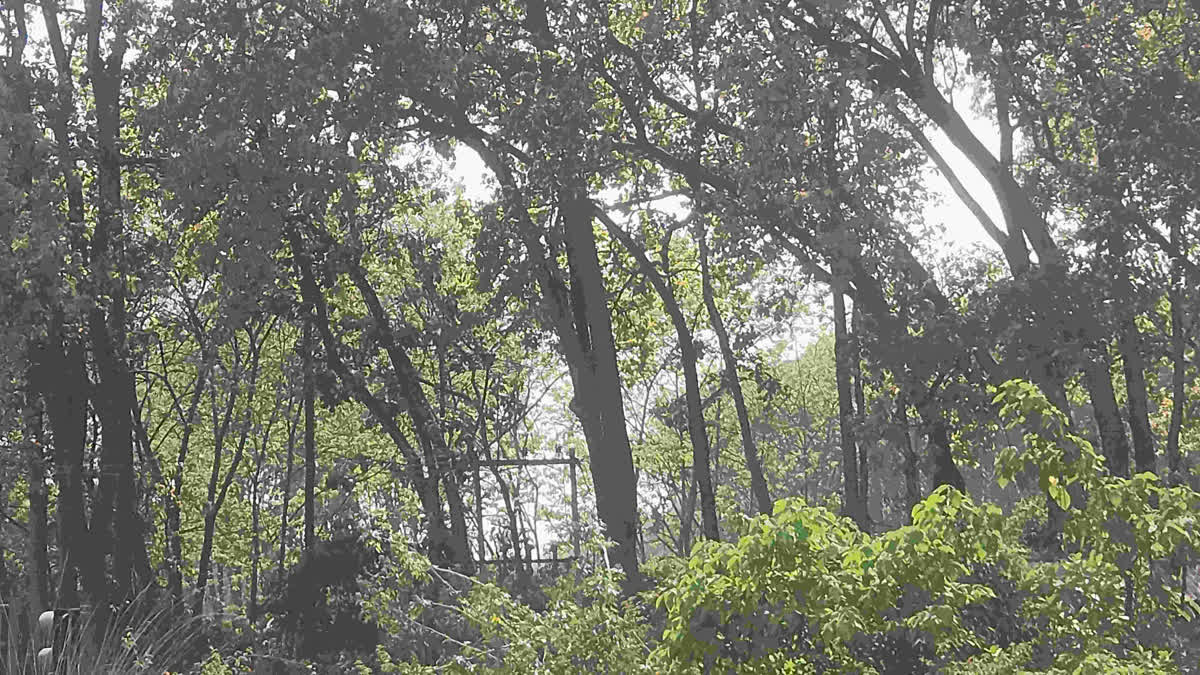
Dehradun: A severe insect infestation has struck the Sal forests in Dehradun where the felling of a large number of trees has become a necessity. The Uttarakhand government has sought permission from the Centre to launch a comprehensive campaign for the removal of affected trees and launch pest control measures.
According to sources, the larvae of ‘Hoplocerambyx spinicornis’—commonly known as the ‘Sal borer’—have caused internal damage to thousands of trees. An infestation of this insect has been detected in a large number of Sal trees across the Thano, Asarori, and Jhajra ranges of the Dehradun Forest Division. The forest department has also sought the assistance of scientists from the Forest Research Institute. The assessment revealed that a total of 19,170 trees were affected.
Experts warn that this insect is extremely dangerous to trees. Its larvae burrow into the roots, tunnelling deep within the trunk, and inflict damage upon the xylem tissue. The xylem is the vital component responsible for transporting water and minerals from the roots to the rest of the tree. When this system is compromised, the tree gradually becomes hollow from the inside out and eventually withers away.
The scent emanating from these logs attracts insects. When the insects land on them, they are captured and destroyed. This process is carried out on a large scale, and local women’s self-help groups play a significant role in it.
Environmental experts claim that the fact that trees are being affected on such a massive scale points to a disruption within the forest’s ecosystem.
Last year, Uttarakhand recorded rainfall levels higher than the seasonal average. Excessive moisture and shifting weather patterns create favourable conditions for such pests to thrive. This is precisely why the ‘Hoplo’ infestation has manifested on a much more widespread scale this time around, say experts.
Forest Minister Subodh Uniyal has stated that a detailed scientific study will be conducted to identify the underlying causes and formulate a long-term solution. According to him, merely felling affected trees or adopting temporary measures will not be enough.
The Sal forests of Dehradun are not only crucial for biodiversity but also play a pivotal role in maintaining local environmental equilibrium. This is because, in addition to producing oxygen, these trees play a crucial role in mitigating pollution. They function by absorbing pollutants and trapping particulate matter.
Further, these trees provide shade and help lower atmospheric temperatures. They also aid in reducing soil erosion by absorbing rainwater.
Share this:
- Click to share on WhatsApp (Opens in new window) WhatsApp
- Click to share on Facebook (Opens in new window) Facebook
- Click to share on X (Opens in new window) X
- Click to share on LinkedIn (Opens in new window) LinkedIn
- Click to share on Telegram (Opens in new window) Telegram
- Click to print (Opens in new window) Print
- Click to share on Tumblr (Opens in new window) Tumblr