
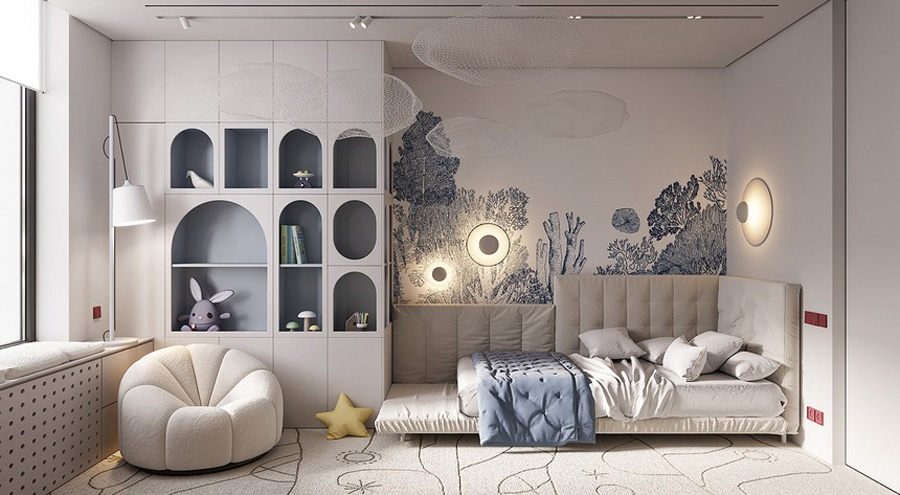
In the past, a child’s bedroom was often an afterthought in home design—a simple space with a twin bed, a wooden desk, and perhaps a colorful rug. Fast forward to 2026, and the “Kids’ Zone” has become one of the most scrutinized and creatively charged segments of residential architecture. Whether purchasing a pre-built villa or constructing a custom home, modern homeowners are viewing children’s rooms not just as sleeping quarters, but as interactive ecosystems designed to foster growth, creativity, and independence.
The rise of “active play” indoors has transformed bedrooms into mini-gyms, with designers now integrating structural elements like indoor rock walls and lofted platforms directly into the room’s bones. Instead of standard bunk beds, many homes feature “stairway-to-heaven” lofts where the bed is high up, accessible by a ladder, and exited via a built-in spiral slide. These adventure hubs are often complemented by carved-out wall alcoves or “treehouse” platforms that provide a cozy escape for quiet reading time.
Modern floor plans are also moving away from the “cluttered box” look toward a zoned strategy. Even in smaller apartments, clever carpentry creates distinct areas such as focus zones with sound-dampening panels and ergonomic desks. A particularly popular trend is the “secret hideout”—a tiny, low-ceiling space or converted closet where kids can have their own private sanctuary.
With a growing awareness of neurodiversity and health, parents are prioritizing sustainability and sensory-friendly elements. Smart LED systems now mimic natural sunlight—bright white for morning study and warm amber for the evening. There is a shift toward natural textures like cork flooring and rattan furniture, paired with muted earth tones like sage green and terracotta, which are proven to reduce anxiety and overstimulation.
One of the most popular requests in custom-built homes is the interactive “canvas wall.” Rather than static wallpaper, designers are installing magnetic chalkboard surfaces and large Lego baseplates mounted directly onto the drywall. Some even include smooth, matte-white wall sections designed to act as home cinemas or interactive gaming screens, allowing the room to evolve as the child’s interests change.
There was also a new trend that emerged recently which is known as Minimalist Montessori concept. It is built on the principle of “freedom within limits.” Unlike traditional rooms that keep toys on high shelves, this design brings everything down to the child’s level. You’ll find floor beds that allow toddlers to get in and out independently, open shelving for “toy rotation” to prevent overstimulation, and a neutral, serene color palette. This design isn’t just an aesthetic choice; it’s a developmental tool that encourages self-reliance and focus from a very young age.
On the other end of the spectrum is the High-Tech Gaming Suite, which is becoming a staple for pre-teens and teenagers. These rooms are designed like high-end cockpits. They feature acoustic slat wood transitions on the walls to manage sound, integrated RGB LED strips that can sync with on-screen action, and “battle stations” that house multi-monitor setups. The unique twist in 2026 is the “transformer” furniture—desks that electronically rise into standing positions and beds that fold into the wall (Murphy style) to create a VR (Virtual Reality) play zone during the day.
While the Montessori room focuses on the physical world and sensory touch, the Gaming Suite focuses on digital immersion and ergonomic performance. Both, however, share the same modern goal: creating a space that isn’t just a place to sleep, but a specialized environment that reflects the inhabitant’s personality and daily activities.
The overall scenario in the child bedroom shift isn’t just about luxury; it’s about psychology. In an increasingly digital world, parents want to provide a physical environment that stimulates the senses and encourages “analog” play. Furthermore, a well-designed, unique children’s room significantly increases the resale value of a home, as young families often make buying decisions based on the “wow factor” of these imaginative spaces. When designing these rooms, the key is modularity—ensuring a castle bed at age five can be converted into a sophisticated loft desk by age twelve.
Share this:
- Click to share on WhatsApp (Opens in new window) WhatsApp
- Click to share on Facebook (Opens in new window) Facebook
- Click to share on X (Opens in new window) X
- Click to share on LinkedIn (Opens in new window) LinkedIn
- Click to share on Telegram (Opens in new window) Telegram
- Click to print (Opens in new window) Print
- Click to share on Tumblr (Opens in new window) Tumblr

Latest Posts
- ‘Issue Unconditional Apology’: Prakash Raj Gets Rs 100 Crore Defamation Warning Over Controversial Remarks On Ramayana
- IndiGo Issues Advisory As Bad Weather Disrupts Flights In Delhi
- WhatsApp Developing Automatic Business Chat Separation To Reduce Inbox Clutter
- Indian Air Force Chief Flies F-15 Fighter Jet During US Visit
- Iran Shuts Hormuz Again, Accuses US Of Violating Deal To Reopen It
- PM Modi To Address Nation At 8:30 PM Today
- ‘Opposition Made A Mistake, Will Face Consequences’: PM Modi On Women’s Quota Bill Failing Parliament Test
- AP Minister Nara Lokesh Celebrates Successful Administration of ₹16 Crore Injection to baby Punarvika
- “Betrayal of the Nation”: AP CM Slams Opposition for Blocking Women’s Reservation Bill
- Revanth Reddy Slams PM Modi Over Women’s Reservation: “A Political Mirage to Deceive the South”
Telangana Updates
-


Telangana
/ 2 months agoNewlyweds Vijay Deverakonda and Rashmika Mandanna Visit Native Village for Housewarming Ceremony
Thummanapet, March 2: Fresh off their fairytale wedding in Udaipur, Tollywood’s most beloved couple,...
-
Telangana
/ 2 months agoOwaisi Demands Clarity on PM Modi’s Israel Visit Following “Operation Roaring Lion” Strikes
Hyderabad, March 1: AIMIM president and Hyderabad MP Asaduddin Owaisi has launched a sharp...
-
Telangana
/ 2 months agoTelangana Transfers 45 IAS Officers in Major Bureaucratic Shake-Up
Hyderabad, Feb 26: Telangana has seen a major reshuffle of IAS officers. Chief Secretary...
-
Telangana
/ 2 months agoYouTuber In Hyderabad Sends Mother In Kuwait “I Love You” Text, Then Kills Self
Hyderabad, Feb 26: A 21-year-old part-time YouTuber and science student, Bonu Komali, was found...


