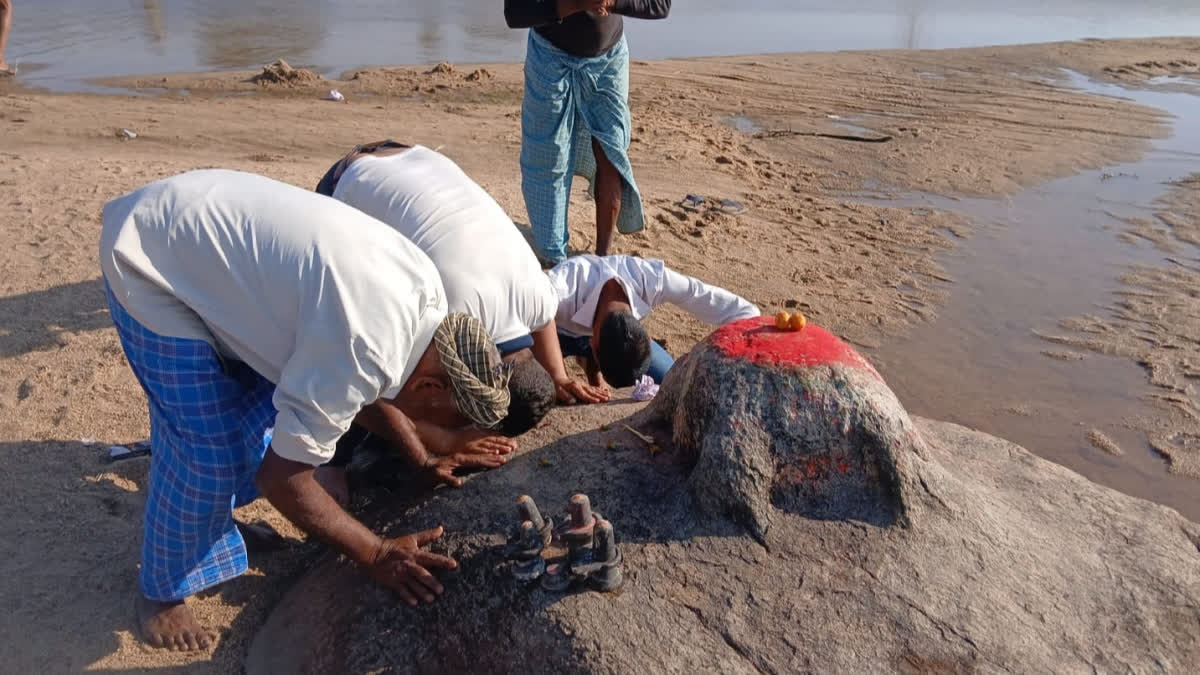
Gaya, Feb 17: A Shivalinga that stands unmoved by floods in the middle of the flowing waters of the Niranjana River, does move, but only with divine intervention, believe villagers of Ladu Dema in Bihar’s Gaya district. Witness to the process, they say the Shivalinga moves inch by inch every passing year and reaffirms their faith in Lord Shiva.
Known as Manokamna Mahadev, Chaturbhuj Mahadev and Budhwa Mahadev, the Shivalinga that has self-manifested since centuries has been one of the most significant spiritual places in the region. Located nearly 60 kilometres from Gaya town, the shrine rises on the riverbed and is worshipped round the year even while being submerged during floods.
Seventy-year-old Kishori Tamoli, a former ward member of Dema Panchayat, says the movement of the Shivalinga is not hearsay, it is real and people can vouch for it. “This Shivalinga movement is nothing short of miraculous. People have been saying that the Shivalinga has shifted for a very long time and they have evidence to prove it,” he adds.
Villagers say their claim is based on regular measuring of the distance between the Shivalinga and a fixed stone on the riverbank using a yardstick.
Balmukund Prasad, a resident of the village, claims the gap has reduced dramatically over decades – from around 136 meters to nearly 50-60 meters. “I remember our ancestors had told us it would move towards Vishnupad. We have been hearing this glory for generations,” he says.
The locals believe, the Shivalinga will be sliding toward the famed Vishnupad Temple, where it will be permanently enshrined one day
Younger villagers like Ankush Kumar Singh and Anil Kumar Singh also say they have been hearing the story since their birth. “The Shivalinga has shifted and it clearly shows but whether it is due to geological shift or a divine will, none can say,” the youngsters stated.
Devotees believe prayers offered here get answered. “Prayers for children, employment, relief from chronic illness and solutions to astrological afflictions are offered here. Chanting of the Mahamrityunjaya Mantra is also conducted every day,” say villagers.
On festivals like Mahashivratri and during the holy month of Sawan, thousands gather on the riverbanks to offer prayers. Bhajans and kirtans continue even when water levels rise. Worshippers wade through shallow currents to offer flowers and milk, not without expressing awe at the movement of the Shivalinga.
Among the many oral legends surrounding the shrine, one story that stands out is about a priest who, years ago, during a severe flood, reportedly drowned while performing rituals. When his body could not be found, his last rites were performed. But 25 days later, the villagers claim he emerged alive near the Shivalinga, holding sandalwood paste and a conch shell. For most, it was the result of divine intervention.
While some may attribute the phenomenon to natural riverbank erosion, sediment shifts, or geological processes, villagers believe its is God’s will. Hundreds of devotees visit the site daily though reaching there is not easy. Devotees brave floodwaters to take darshan of the Shivalinga amid chants of “Har Har Mahadev.”
Share this:
- Click to share on WhatsApp (Opens in new window) WhatsApp
- Click to share on Facebook (Opens in new window) Facebook
- Click to share on X (Opens in new window) X
- Click to share on LinkedIn (Opens in new window) LinkedIn
- Click to share on Telegram (Opens in new window) Telegram
- Click to print (Opens in new window) Print
- Click to share on Tumblr (Opens in new window) Tumblr