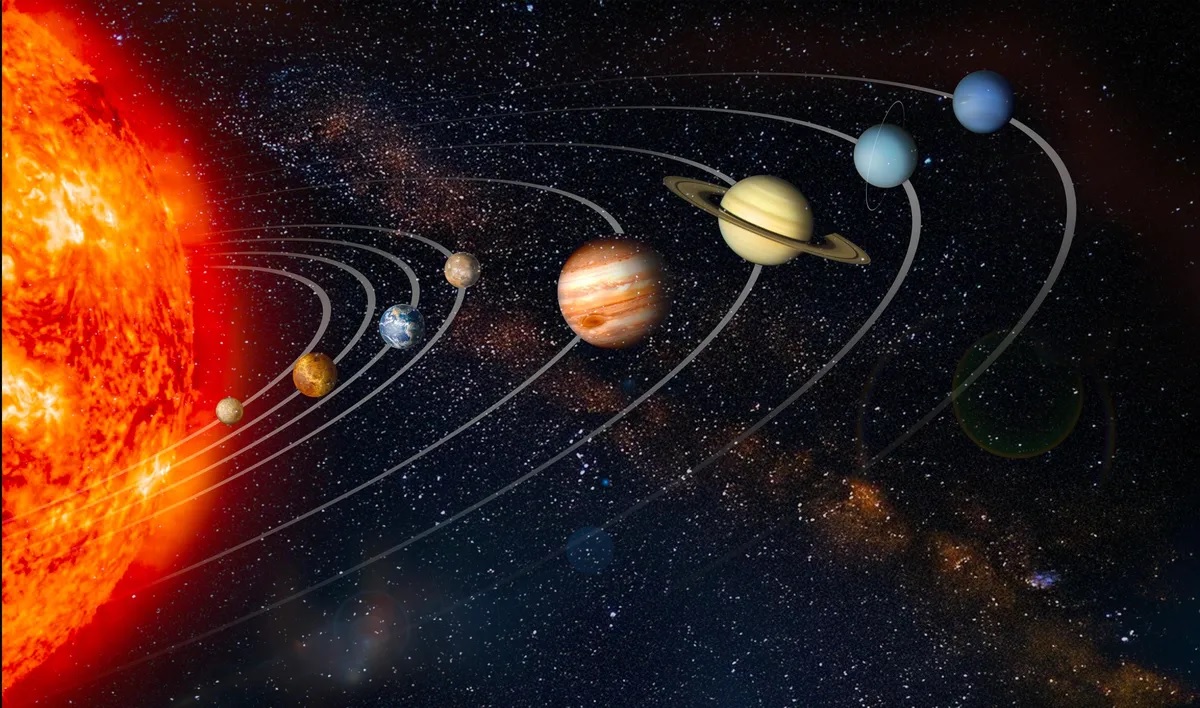
Ancient astronomers noticed fairly early on in their studies of the sky that the planets all tended to stay pretty close to the ecliptic, the path the Sun appears to take through the skies. The alignment is not perfect, or Venus and Mercury would transit across the face of the Sun frequently and closer planets would often block out more distant ones as they appear to pass. Nevertheless, the deviation is never more than a few degrees.
Once Copernicus demoted the Earth from the center of the universe to another orbiter of the Sun, it was recognized that this appearance of planetary herding reflected the planet’s orbits being within seven degrees of each other (even closer if we ignore Mercury). That raises the question: why?
With six planets recognized post-Copernicus, this alignment could not be a coincidence. Moreover, some unruly comets proved it’s quite possible for objects to have orbits closer to right angles with the main planetary plane than aligned with it.
Uranus and Neptune also fitted rather well into the pattern, while the fact that Pluto does not may have subconsciously contributed to its demotion.
After Newton, one explanation became an obvious contender. Jupiter’s immense gravity acts like a sheepdog, herding the other planets. Any smaller world that gets too far out of the plane will feel a constant tug from Jupiter pulling it back.
Yet a few things kept astronomers wondering whether that was the whole story.
For one thing, while most asteroids also orbit close to the same plane, not all of them do. Clearly it is possible to defy Jupiter’s authority and get away with it to some extent. Out where comets spend most of their time, the king of planets’ rule is very weak, so why was Neptune in formation?
Another relevant fact is that the shared orbital plane is also angled just 6 degrees to the Sun’s equator, as revealed by sunspots’ motion. Finally, there was the fact that most moons, and the gas giants’ rings, orbit close to the equatorial plane of their planet.
Born this way
Astronomers started to suspect that this strong alignment reflected a common birth. If the planets formed out of a disk, which orbited around the young Sun, then they would have been in aligned orbits from the start. Only something big would throw a planet out.
As improving telescopes gave us the power to see what was happening shortly after stars first shine, the theory was confirmed. We see protoplanetary disks around many young stars, sometimes with gaps cleared by newborn planets.
That, of course, moves the question back one step: what produces the disks from which planets form?
Stars and their planets form from nebulae, clouds of mostly molecular hydrogen, sprinkled with other elements from past supernovae. These clouds are initially enormous and the molecules thinly spaced, but slowly condense under gravity.
Individual molecules in these clouds move in every direction, but overall there is still an average angular momentum, with the cloud on average rotating thanks to the gravitational influences around it. Like figure skaters speeding up as they draw their limbs in, nebulae must turn faster as they condense to maintain angular momentum. There’s so much shrinkage that even exceptionally slow rotation initially leads to a rapid rate of spin.
The faster an object turns, the more it is forced to flatten out, a law that applies at scales from galaxies down to pizza dough. The spin stops the cloud collapsing inward to the star, but allows a squeeze parallel to the axis of rotation.
When stars and planets form, they inherit the angular momentum, which the star expresses by rotating, and the planets by circling it. A similar process on a smaller scale leads to the formation of moons around giant planets.
Always some exceptions
Along with the disks we can see, we know that most planetary systems show similar alignments. When the Kepler and TESS space telescopes watch out for the regular dips in brightness that signal the passage of a planet between its star and us, it’s common to find more than one. Famously, in the case of TRAPPIST-1, there are seven planets that all orbit in such a perfect plane (just 0.1 degree divergence) that they block a little of their star’s light every time. They’re also closesly aligned with the star’s equator.
No doubt many of these systems have some planets that aren’t in the plane. However, unless their orbits were very far out, or their masses very small, we’d know about such planets around the better studied stars, because of their gravitational influence on the planets whose silhouette we see. Consequently, we can tell that close alignment is the norm.
Nevertheless, there are always a few systems that insist on not playing by the rules, forcing us to create new rules to accommodate them.
One such example is 2M1510, a pair of brown dwarfs that appear to be orbited by a planet whose orbital plane is perpendicular to one of the dwarf pair.
Another oddity, K2-290’s main star spins almost backwards compared to its known planets. In that case, it is thought a distant companion star or passing stranger caused some major remodeling.
We don’t know why these oddities exist, but it does seem they’re mostly concentrated in multi-star systems. For KOI-5, for example, the stars are thought to have created complexity that can turn to chaos.
Perhaps the most confusing of all the known anomalies is HD3167, where one planet has an ordinary orbit aligned with the star’s equator, another goes over the poles, and a third is uncertain. That would be a strange combination under any circumstances, but it’s made even harder to explain by the fact all three are very close to their star, where disruption is harder.
Share this:
- Click to share on WhatsApp (Opens in new window) WhatsApp
- Click to share on Facebook (Opens in new window) Facebook
- Click to share on X (Opens in new window) X
- Click to share on LinkedIn (Opens in new window) LinkedIn
- Click to share on Telegram (Opens in new window) Telegram
- Click to print (Opens in new window) Print
- Click to share on Tumblr (Opens in new window) Tumblr