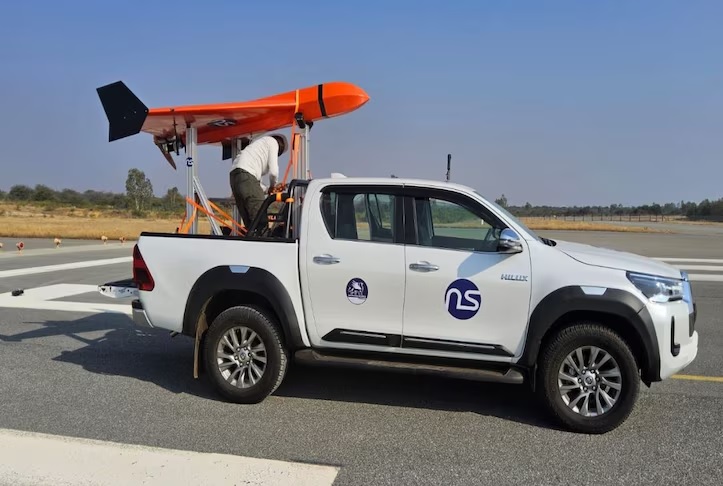
New Delhi, March 4: As the world watches Iran’s Shahed-136 low-cost suicide drones and America’s own Shahed-inspired LUCAS drones exact disproportionate damage on the battlefield for a fraction of the cost of conventional weapons, India’s own answer to this class of warfare, the Sheshnaag-150, is quietly but steadily making headway in development testing.
The long-range swarming attack drone, built from scratch by Bengaluru-based defence startup Newspace Research Technologies (NRT), first flew a year ago. But in the wake of Operation Sindoor, during which NRT was called upon by the Indian military to deploy some of its other drone capabilities at the warfront, the urgency around a mature, home-grown, long-range swarming strike capability has sharpened dramatically. What was once a promising internal development program is now viewed through a far more operationally urgent lens.
The timing could not be more instructive. The ongoing eruption in the Middle East has offered the world a masterclass in asymmetric drone warfare. The Iranian Shahed-136, from which the Sheshnaag draws some conceptual lineage, has repeatedly punched far above its weight, overwhelming air defences through sheer mass and saturation, striking high-value targets for costs that border on the ludicrous.
The LUCAS, America’s own low-cost derivative inspired by the Shahed template, has reinforced the lesson: in modern warfare, cheap, autonomous, and numerous can beat expensive and singular. Even within the Indian military, the case for Sheshnaag-class systems has arguably never been stronger, and this is driving a Sindoor-powered doctrinal shift towards drone warfare.
The Sheshnaag-150 is designed for coordinated swarm attacks, allowing multiple drones to overwhelm enemy defences and execute precision strikes. With an operational range of over 1,000 km and endurance exceeding five hours, it can loiter over target areas, providing real-time surveillance and attack options. It is capable of autonomously identifying, tracking, and engaging enemy targets with minimal or no human intervention, and can carry warheads of 25-40 kg, sufficient to cause serious damage to infrastructure, vehicles, or personnel.
But the flying vehicle itself is almost beside the point. The real meat of the Sheshnaag system is the proprietary mother-code that will control the Sheshnaag-150 and its cousin systems. Building small air vehicles isn’t overly complex. Developing the algorithmic “secret sauce” that converts them into intelligent, resilient, constantly self-refreshing weapons that talk to each other and autonomously chart efficient attack plans is a whole different matter.
The LUCAS is a technological step up from the Shahed-136, plugged as it is into Elon Musk’s Starlink internet ecosystem for unhackable guidance. India’s Sheshnaag-150 seeks to go a step further, and will ultimately sport a visual navigation system that enables operations in environments where global navigation satellite systems are denied.
During Operation Sindoor, Pakistan launched hundreds of low-cost drones not just to attack, but to saturate Indian air defences, deplete Indian resources and identify offensive ground positions by forcing them to fire. While an overwhelming number of those drones were easily destroyed before they could complete their attack or mapping mission, Pakistan use of such drones reflected a doctrinal shift.
On the contrary, India deployed a smaller, but far more effective, number of purpose-built attack drones and loitering munitions that successfully found their targets and debilitated swathes of air defence and radar units, allowing the Indian Air Force to paralyse what was left of Pakistan’s air power posture.
Operation Epic Fury, Operation Sindoor before it and the meandering war in Ukraine, have made things clear: the drone age has arrived at India’s doorstep. Low cost, expendable weapons may well be the country’s most consequential current answer to existing threats.