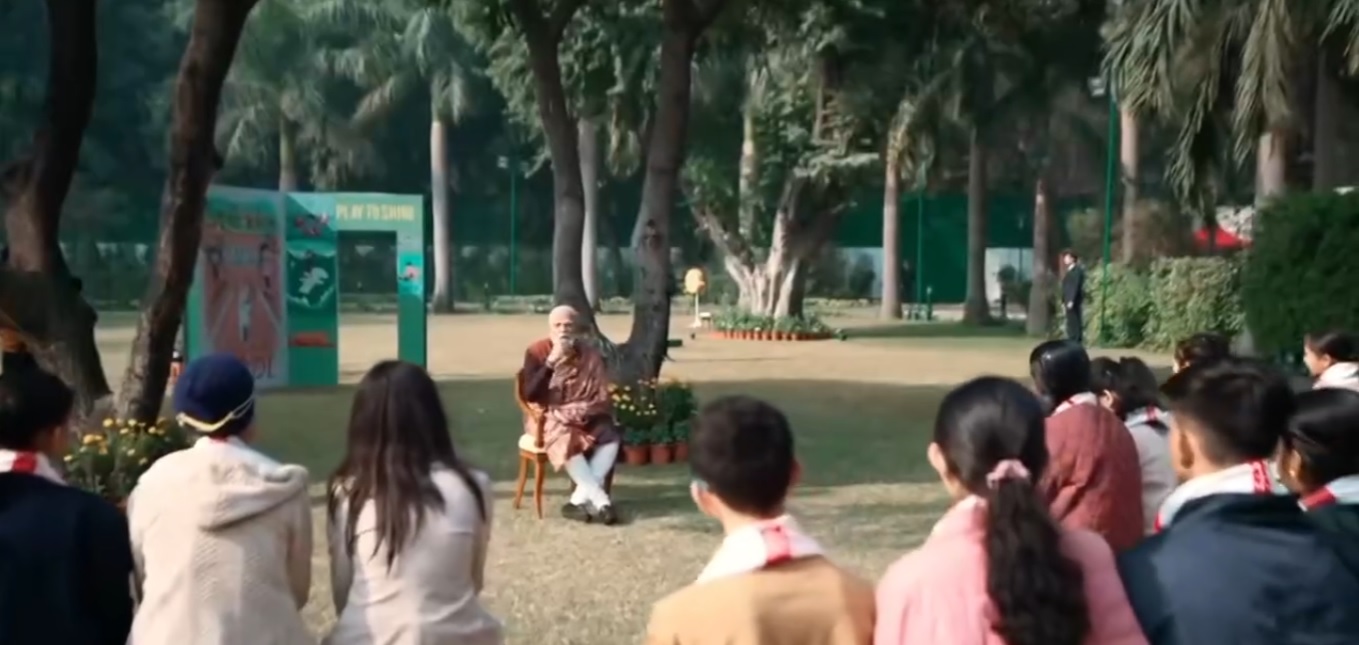
New Delhi, Feb 6: Pariksha Pe Charcha continued with a strong emphasis on ambition, responsibility, and the role students would play in shaping India’s future as Prime Minister Narendra Modi addressed learners through Chapters 7 and 8: Big Dreams and Bigger Action and When the PM Becomes a Teacher, respectively.
In one of the most striking moments of the session, PM Modi shared a video he had recently come across on social media. It showed a father travelling to Belgadi with his belongings to earn a living, while his young child sat atop the luggage in the vehicle, deeply absorbed in reading a book. The image, he said, stayed with him.
The Prime Minister told students that the child’s focus, despite discomfort, carried a powerful message. Comfort, he noted, does not guarantee success, and lack of it should never stop anyone from learning. “Not dreaming is the real loss,” he told students, encouraging them to think big, stay focused on their work, and keep moving forward regardless of obstacles.
He also urged students to read biographies, saying that learning about other people’s journeys broadens perspective. Often, he observed, young people only see what lies immediately in front of them. Reading about lives beyond one’s own surroundings can open doors to new possibilities and inspire perseverance.
.
As the interaction progressed, PM Modi took on the role of a classroom teacher, speaking about India’s long-term vision of becoming a developed nation by 2047, marking 100 years of Independence. In his words to the students, he posed the question to them as to how old they would be then and the burden of the task would be on their shoulders to achieve the goal.
Lessons for a Viksit Bharat Classroom:
In an address, while speaking as a teacher, PM Modi suggested simple yet impactful ideas that describe what a Viksit Bharat classroom should look like. He said good teachers do not limit learning to scoring marks but ensure students understand the entire syllabus, its real-life applications, and the purpose of technology in their lives.
He pointed out that today’s students have access to opportunities that did not exist in earlier generations, especially in the field of technology. However, he cautioned that access alone is not enough. “To use technology correctly, one has to develop intellect,” he said, stressing that tools must strengthen thinking, not replace it.
Share this:
- Click to share on WhatsApp (Opens in new window) WhatsApp
- Click to share on Facebook (Opens in new window) Facebook
- Click to share on X (Opens in new window) X
- Click to share on LinkedIn (Opens in new window) LinkedIn
- Click to share on Telegram (Opens in new window) Telegram
- Click to print (Opens in new window) Print
- Click to share on Tumblr (Opens in new window) Tumblr