The verified 12-disk stacking technology represents an important move by Toshiba to stay competitive in the cloud and enterprise storage markets. In hyperscale data centers, where cost efficiency and reliability matter more than raw speed, high-capacity HDDs continue to play a vital role. By combining proven MAMR technology with advances in materials engineering, Toshiba is working to extend the usefulness of mechanical drives in increasingly data-intensive environments.
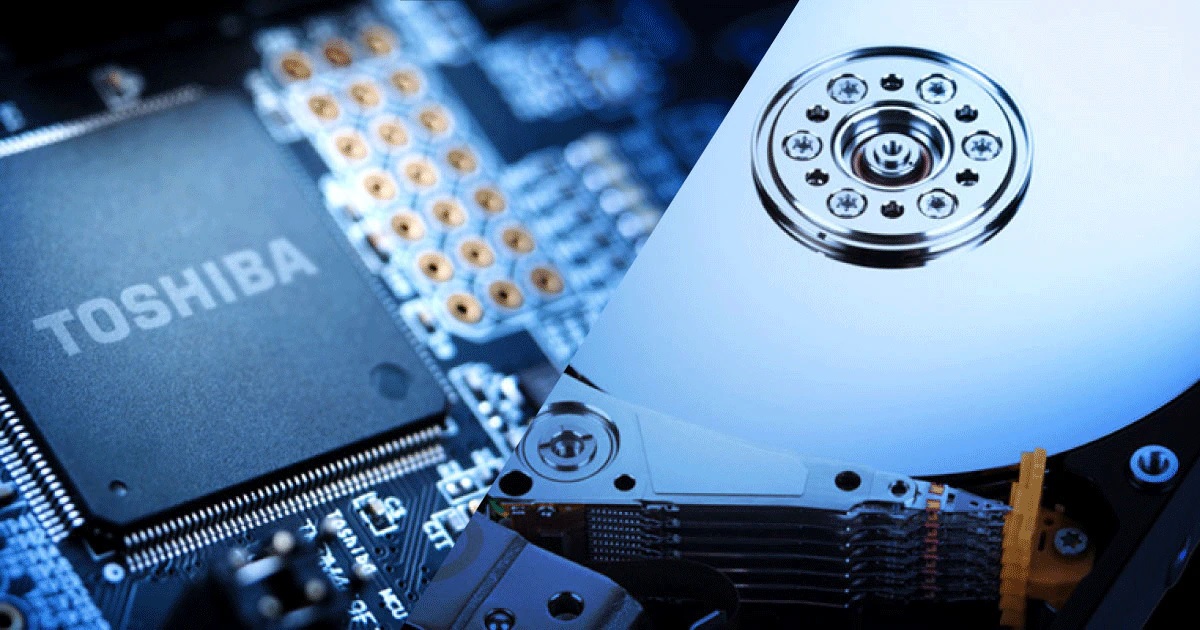
Toshiba has reached a new engineering milestone in hard drive technology, becoming the first manufacturer to verify a 12-disk stacking design within the standard 3.5-inch hard drive enclosure. The achievement extends the physical limits of current hard drive engineering, surpassing competitors that have not yet moved beyond 10-disk configurations. The company expects the new structure to pave the way for commercial 40-terabyte data center models by 2027.
Achieving that increase in disk count required extensive redesigns at the mechanical level. Toshiba engineers replaced traditional aluminum platter substrates with glass, which allows for thinner disks without reducing stability or structural integrity. The move toward glass-based platters is central to the company’s ability to fit 20 percent more disks into the same physical footprint. Each platter in a hard drive serves as a magnetic surface for storing data, so increasing the number raises total capacity while keeping the form factor constant.
These improvements help counter physical vibrations and spindle deviations that can emerge when more platters rotate within tight tolerances. The result, Toshiba says, is higher recording density along with better durability and reliability.
The company’s storage roadmap indicates that the 12-disk configuration will debut in products built around its Microwave-Assisted Magnetic Recording, or MAMR, technology – a recording system that uses microwaves to reduce magnetic resistance during data writing. Toshiba plans to introduce these MAMR-driven 40TB drives in 2027, targeting data center operators who need higher-capacity mechanical storage without abandoning established reliability metrics. MAMR represents Toshiba’s alternative to the more experimental Heat-Assisted Magnetic Recording, or HAMR, technology being pursued by some competitors.
While Toshiba continues to refine MAMR-based designs, it has confirmed that development work is also underway on future HAMR drives. HAMR technology uses localized heat from a laser to momentarily make the magnetic media easier to write, enabling even greater density increases.
Seagate and Western Digital have focused heavily on this approach, with Seagate projecting HAMR capacities exceeding 100TB by 2030. Toshiba’s more cautious adoption path has centered on incremental density improvements and mechanical innovations rather than immediate heat-assisted implementation.
If realized on schedule, Toshiba’s drives could arrive just as large cloud providers face mounting storage density challenges. With the industry’s focus increasingly split between flash and magnetic storage, the company’s work demonstrates that even after decades of development, the hard drive continues to evolve.