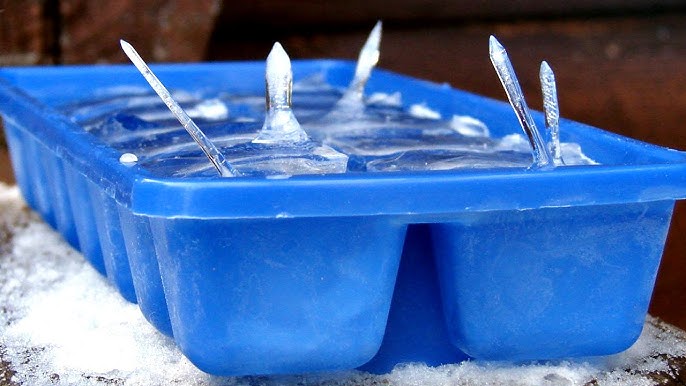
Do the humble ice cubes in your freezer have aspirations of becoming icicles? Though they won’t reach the roof, they do seem to defy gravity and grow upwards. These tiny spikes atop ice cubes represent a beautiful story of growth from liquid water into spiky crowns. Let’s take a deep dive into the life of an ice cube spike.
At the heart of this story is water’s unique ability to expand when it freezes, unlike other liquids, which contract when they freeze.
Ice cube spikes, like the cube itself, begin their journey as water that gets put into the freezer tray. The environment here is much colder and the water is already in the form of cubes, as shaped by the tray. The cubes don’t freeze uniformly, as the layers of water on the boundaries are colder than the water inside.
Think about standing in a big group of people on a chilly winter day. The people who form the outer layer of the group feel much colder than those in the middle. When the same thing happens to a layer of water, it starts freezing from the outside. Unlike other liquids, water expands when it is cooled. This happens because the water molecules need to move apart from each other to arrange themselves in a hexagonal pattern when they freeze.
As the outer layers or the layers in contact with the tray or air freeze and take up increasingly more volume, the water in the middle gets squeezed. As more of this water freezes, the squeezing gets stronger and the increase in pressure will push the liquid outwards to release the pressure.
Of course, this is not possible through the sides, where the tray supports the outer layers of ice, so the only practical way out for the water is through a weak point at the top. If there is a small weak point on the top, water spurts out, but only a tiny bit. Remember, we’re only talking about a small opening on the top of an ice cube.
Having come out of the cube and into contact with very cold air, the outer layer quickly freezes, leaving the inner part liquid. At this point, the ice spike is more like a tube or straw with a hollow inner part and a solid outer part. As the process of freezing makes its way further inside the cube, water keeps getting squeezed and forced to find a possible escape route.
This escape comes in the form of the weak point that has already been created, and the new water pushes up through the tube. The process continues until the tip is tapered off due to freezing, or once it has relieved all the pressure due to expansion.
Share this:
- Click to share on WhatsApp (Opens in new window) WhatsApp
- Click to share on Facebook (Opens in new window) Facebook
- Click to share on X (Opens in new window) X
- Click to share on LinkedIn (Opens in new window) LinkedIn
- Click to share on Telegram (Opens in new window) Telegram
- Click to print (Opens in new window) Print
- Click to share on Tumblr (Opens in new window) Tumblr