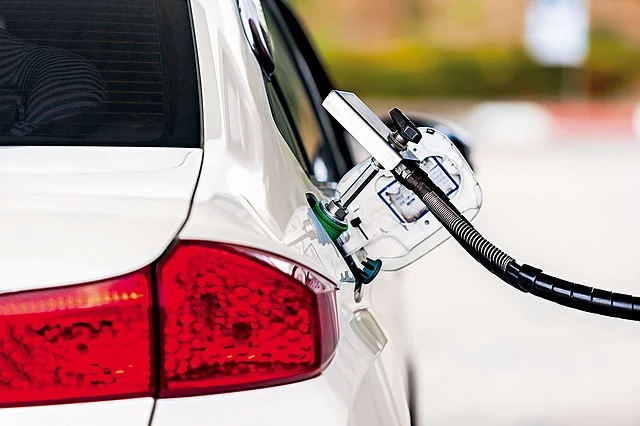
Mumbai, Jan 19: The rapid rise of CNG vehicles and its popularity is not quite as old as it may seem from the hustle and bustle of the filling stations. As recently as two years ago (2022–23), CNG vehicles used to make up for 20% of the total sales of India’s largest carmaker Maruti Suzuki. However, by 2024–25, it rose to 33%. Similarly, rival Tata’s CNG share soared from 3% in 2021–22, even lower than its EV share then, to 25% in 2024–25—well clear of its EV sales. For the industry as a whole, the share of CNG cars has almost doubled to 19.3% from about 10% in the same period, and the sales of CNG four-wheelers have increased each fiscal since 2019–20—going from 1.8 lakh units to 4.8 lakh last year, even during the two years when total four-wheeler sales fell.
Yet, there has been no new subsidy scheme, no policy incentive to drive CNG sales in the past 2–3 years. So, what explains the sudden rise, and what does it mean for the Centre’s attempts to popularise EVs?
The credit for making CNG mainstream in India must go to the courts, which saw in the fuel a way out for India’s cities from the haze of pollution that enveloped them at the turn of the millennia. Indeed, CNG cars emit 18% less carbon dioxide, 65% less carbon monoxide and over 30% less nitrogen oxides than petrol vehicles, according to a study by the US National Renewable Energy Laboratory. But for nearly two decades, it remained largely confined to public-transport fleets.
The first change came with the introduction of Bharat Stage (BS) VI emission norms in 2020. Overnight, small diesel cars became unviable, leaving CNG as the only cheaper alternative to petrol. Even today, CNG’s economics are tough to beat.
“If you see the mass market—below ₹12–13 lakh—EVs are more or less missing for all players except Tata. However, range constraints persist even in Tata’s products,” says Puneet Gupta, director, India & Asean automotive market, S&P Global Mobility, a data provider.
In fact, a 2024 report from credit-rating agency CareEdge Ratings found that EVs were 80% costlier than petrol cars, compared to a 12% premium for their CNG variants. Much of this price differential can be attributed to the maturity of the underlying propulsion technology and the manufacturing ecosystem around it. A CNG engine still is an internal combustion engine (ICE) with some modifications to enable it to run on gas. Hence, companies could convert existing models without the capital expenditure required for electric platforms.
EVs, by contrast, rely on an entirely different supply chain—a nascent one. On the other hand, India has built a world-class ICE manufacturing ecosystem over four decades with components and vehicles being exported to the US and Europe. Despite government incentives to localise battery manufacturing, no company barring Ola Electric has achieved commercial-scale production so far.
Share this:
- Click to share on WhatsApp (Opens in new window) WhatsApp
- Click to share on Facebook (Opens in new window) Facebook
- Click to share on X (Opens in new window) X
- Click to share on LinkedIn (Opens in new window) LinkedIn
- Click to share on Telegram (Opens in new window) Telegram
- Click to print (Opens in new window) Print
- Click to share on Tumblr (Opens in new window) Tumblr