Scientists have discovered a mysterious ‘iron bar’ in the heart of a nearby nebula that could offer a glimpse into Earth’s grizzly fate.
The strip of ionised iron atoms was spotted stretching across the Ring Nebula, located 2,283 light-years from Earth.
Experts are baffled about how it formed, as scientists have never seen anything like it before.
But they say it could be the remains of an Earth-like rocky planet that was vaporised by a dying star.
When stars like our sun run out of nuclear fuel at the end of their lives, the outer layers balloon to enormous size even as the core shrinks and cools.
Eventually, the core becomes a tiny white dwarf without enough gravity to hold the star together, and the outer layers are shed to leave behind a planetary nebula.
In about five billion years from now, our sun will undergo the same transformation as it swells into an enormous red giant and swallows Earth.
In a new paper, researchers say this never-before-seen structure in the Ring Nebula could reveal what Earth would look like after being destroyed by the sun.
Scientists have spotted a mysterious iron ‘bar’ at the centre of the Ring Nebula, and it could offer a glimpse of Earth’s grim future
The Ring Nebula is one of the closest and most spectacular planetary nebulae visible from Earth.
Astronomers believe that it formed when a dying star shed its outer layers about 4,000 years ago.
The main ring of the nebula is made up of 20,000 clumps of dense molecular hydrogen gas, each about the mass of the Earth.
Because this nebula is so hot and close to Earth, scientists often use it to trial new telescopes and equipment before looking for more distant objects.
In this new study, scientists looked at the Ring Nebula using a new tool called the Large Integral Field Unit (LIFU), mounted on the William Herschel Telescope.
This is essentially a bundle containing hundreds of fibre-optic wires that allow scientists to look at the different wavelengths of light, or spectra, across the entire face of the nebula.
Lead author Dr Roger Wesson, of Cardiff University and University College London, says: ‘By obtaining a spectrum continuously across the whole nebula, we can create images of the nebula at any wavelength and determine its chemical composition at any position.
‘When we processed the data and scrolled through the images, one thing popped out as clear as anything – this previously unknown “bar” of ionised iron atoms, in the middle of the familiar and iconic ring.’
The strip of ionised iron atoms was spotted stretching across the Ring Nebula, located 2,283 light-years from Earth
Astronomers believe that the Ring Nebula formed when a dying star shed its outer layers about 4,000 years ago
A star’s life cycle
Around 90 per cent of stars in the sun are what scientists call ‘main sequence’ stars.
These are stars that fuse hydrogen into helium in their cores, and range from about a tenth of the mass of the sun to about 200 times as massive.
Main sequence stars start as clouds of gas and dust, which collapse under gravity into ‘protostars’.
When a protostar is dense enough, the pressure and heat start nuclear fusion and a star is born.
Stars keep burning helium until it runs out in around 10 to 20 billion years.
At this point, stars will enter the post–main sequence phase and become red dwarfs, white dwarfs, red giants, or even explode into neutron stars, depending on their size.
The researchers aren’t actually sure how this strange bar might have been formed, but there are two likely scenarios.
Either the bar was made by some unknown process during the ejection of the nebula as the parent star collapsed, or it is an arc of plasma resulting from the vaporisation of a rocky planet caught up in the star’s earlier expansion.
‘We know that there are planets around many stars, and if there were planets around the star that formed the Ring Nebula, they would have vaporised when the star became a red giant,’ Dr Wesson told the Daily Mail.
‘And the mass of iron in the bar is about what you’d expect from the vaporisation of a planet: if Mercury or Mars were vaporised, that would give a bit less iron than the bar in the Ring, while if Earth or Venus were vaporised, it would give a bit more.’
If the latter is true, then this strange structure could be a fascinating look at how our planet might appear to astronomers billions of years in the future.
Main-sequence stars like our sun are stable because the inward forces of gravity are matched by the outward push of nuclear fusion reactions in the core.
However, when the star runs out of hydrogen fuel, it can’t sustain that reaction and the outer layers start to collapse inwards.
The pressure from this collapse creates such intense heat that it can fuse helium atoms into carbon, releasing a surge of energy that kickstarts nuclear fusion in the outer layers.
One possible explanation is that the iron bar is the remains of a rocky planet that was engulfed by its star as the outer layers expanded to form the nebula. Earth is likely to suffer this same fate when the sun starts to run out of fuel in five billion years’ time
The outer layers then expand and cool into what is known as a Red Giant, becoming anywhere from 100 to 1,000 times larger.
When this happens to our sun in about five billion years’ time, scientists think it is very likely that Earth will be destroyed.
As the sun expands, Earth will either be vaporised by the intense heat or torn to peices and pulled in by the powerful gravitational tidal forces. In a paper published last year, scientists found that stars which had already expanded into red giants were much less likely to host large, close orbiting planets like Earth.
Overall, 0.28 per cent of stars surveyed were home to a giant planet, with the youngest stars in the sequence having planets more frequently.
However, for stars that had already grown enough to be classed as red giants, just 0.11 per cent were home to planets.
When this does happen, Earth might be smeared into something very much like the iron bar seen in the Ring Nebula.
However, the researchers say they still need a lot more evidence before they can say for certain whether the bar was left by a planet.
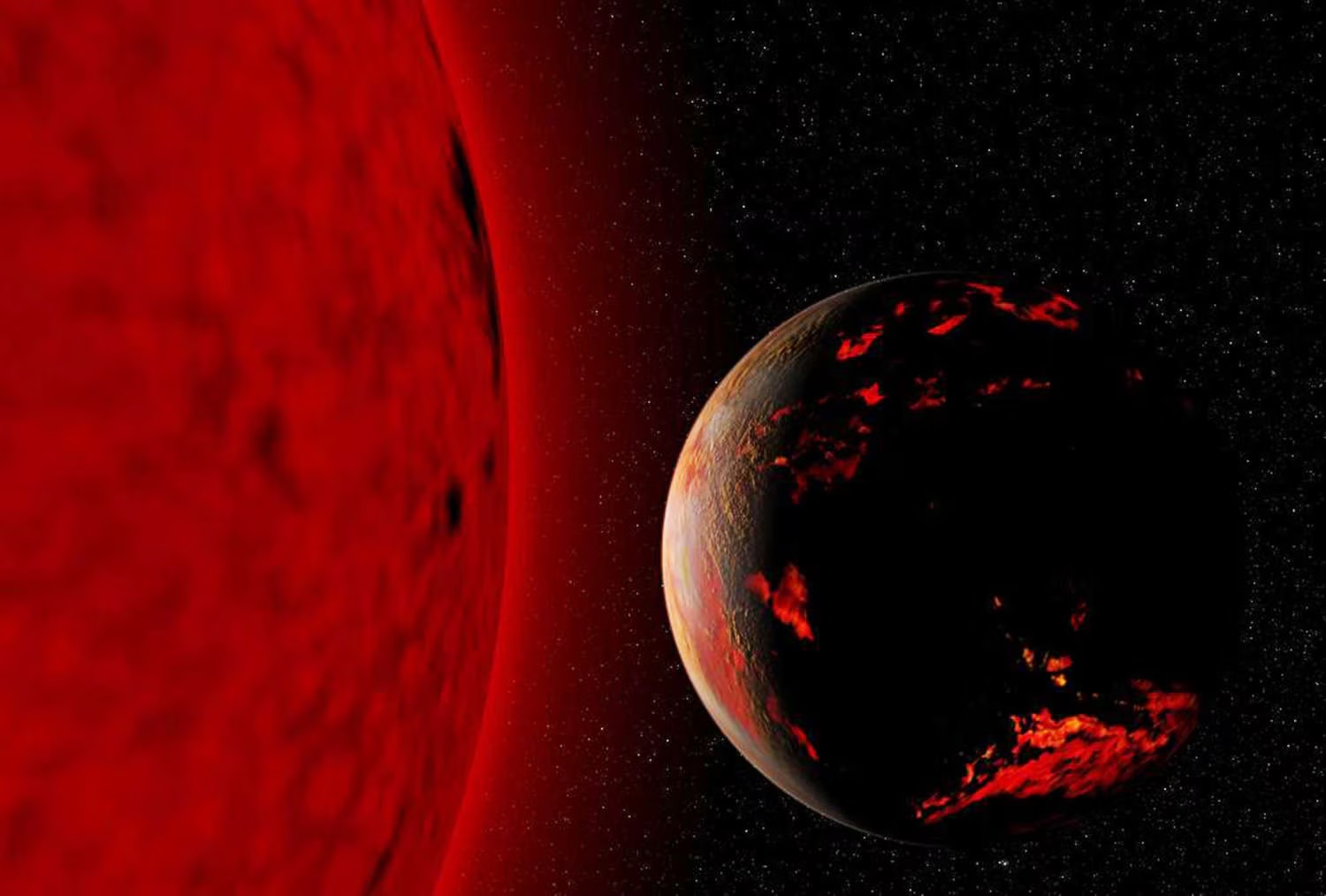
In about five billion years, scientists say that the sun will burn the last of its hydrogen fuel. When this happens, it will expand to about 200 times its current size to become a red giant and destroy Earth (artist’s impression)
Dr Wesson says: ‘A vaporised planet is a possibility. But it’s not the only possibility, and we’d have to work out how the iron ended up in a bar shape if it did come from a planet.
‘More likely, there are iron “bars” waiting to be found in other nebulae. The more we can find, the more information we will have to determine how they formed, so we’re hunting for more of them!’
In the future, the researchers hope to use the LIFU tool to find more nebulae with similar features, to try to figure out where the bar might have come from.
Co-author Professor Janet Drew, of University College London, says: ‘We definitely need to know more – particularly whether any other chemical elements co-exist with the newly-detected iron, as this would probably tell us the right class of model to pursue.
‘Right now, we are missing this important information.’
What will happen to Earth when the Sun dies?
Five billion years from now, it’s said the Sun will have grown into a red giant star, more than a hundred times larger than its current size.
Eventually, it will eject gas and dust to create an ‘envelope’ accounting for as much as half its mass.
The core will become a tiny white dwarf star. This will shine for thousands of years, illuminating the envelope to create a ring-shaped planetary nebula.
Five billion years from now, it’s said the Sun will have grown into a red giant star, more than a hundred times larger than its current size
While this metamorphosis will change the solar system, scientists are unsure what will happen to the third rock from the Sun.
We already know that our Sun will be bigger and brighter, so that it will probably destroy any form of life on our planet.
But whether the Earth’s rocky core will survive is uncertain.

Latest Posts
- TG HC Issue Notices to Tatha Madhu, Naveen
- US Influencer Fights 6-Foot Robot In World’s First ‘Human Vs Terminator’ Match
- BRS Cadre Arrest in Palamuru District is Illegal Detention: KTR
- Railways Revise Wagon Hire Charges
- Pawan Kalyan Inagurates Peethikapuravanam Urban Forest in Peethapuram
- Apple Initiates Second Round of Job Cuts in Two Months
- IIT Bombay Apologises for Remarks Following Student Suicide
- Two Indian Nationals Were Killed in a Trainee Aircraft Crash in Canada
- Congress Questions PM Modi on Price Rise and Inflation
- India’s Medal Tally Reaches Six in Asian Games
Telangana Updates
-

Telangana
/ 12 hours agoTG HC Issue Notices to Tatha Madhu, Naveen
HYDERABAD: The High Court for the State of Telangana has issued notices to Bharat...
-


Telangana
/ 13 hours agoBRS Cadre Arrest in Palamuru District is Illegal Detention: KTR
HYDERABAD: BRS Working President Kalvakuntla Rama Rao vehemently criticized the Revanth Reddy govt for...
-


Telangana
/ 1 week agoIMD Issues Yellow Alert for Heavy Rains in Telangana Over Next 48 Hours
HYDERABAD: The India Meteorological Department (IMD) center in Hyderabad has issued a yellow alert...
-


Telangana
/ 1 week agoKTR Slams Govt Over Sexual Harassment Cases Against BRS Legislators, Terming It Shocking
HYDERABAD: Bharat Rashtra Samithi (BRS) Working President K.T. Rama Rao (KTR) launched a blistering...