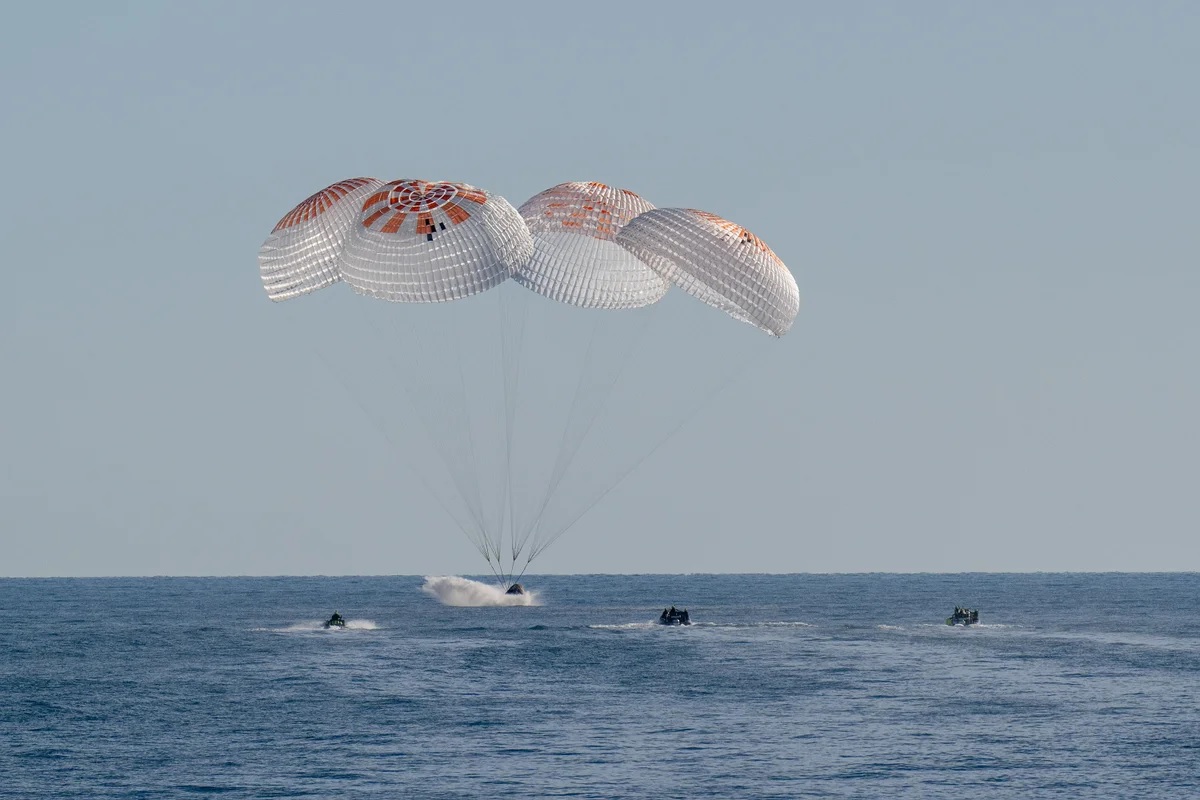
San Diego, Jan 15: Four astronauts are safely back on Earth after the first-ever medical evacuation of the International Space Station. A SpaceX Crew Dragon capsule carrying NASA’s Mike Fincke and Zena Cardman, Japan’s Kimiya Yui and cosmonaut Oleg Platonov splashed down in the Pacific Ocean off the coast of San Diego today (Jan. 15) at 3:41 a.m. EST (0841 GMT; 12:41 a.m. California time), about 10.5 hours after undocking from the orbiting lab.
The quartet were supposed to stay in space for another month or so but came home early because one crewmember experienced a medical issue. It was the first time in the history of the International Space Station (ISS) that a mission had been shortened due to astronaut health reasons.
A ‘medical concern’ arises in orbit
Fincke, Cardman, Yui and Platonov launched toward the ISS on Aug. 1, 2025, kicking off SpaceX’s Crew-11 mission to the orbiting lab for NASA. Ordinarily, such crew-rotation flights last about six months, ending a few days after their successors arrive at the ISS. But something out of the ordinary happened during Crew-11’s home stretch.
On Jan. 7, NASA announced it was canceling a Jan. 8 spacewalk by Cardman and Fincke due to a “medical concern” with an ISS crewmember. A day later, the agency said it was ending Crew-11 early to address that concern.
NASA has not identified the affected astronaut or given details about the health issue, citing privacy concerns. But the agency has said the crewmember is stable, stressing that this is not a crisis situation.
“It is not an emergency de-orbit, even though we always retain that capability, and NASA and our partners train for that routinely,” NASA Administrator Jared Isaacman told reporters during a press conference on Jan. 8. Rather, he added, the mission team decided to bring Crew-11 home early because “the capability to diagnose and treat this properly does not live on the International Space Station.”
The Crew-11 mission lasted 167 days, with 165 of them spent aboard the ISS. It was the first spaceflight for Cardman and Platonov, the second for Yui and the fourth for Fincke. Yui has now spent a total of 309 days in space, while Fincke’s accumulated off-Earth time is 549 days.
“It’s so good to be home!” Cardman, Crew-11’s commander, said shortly after splashdown. “With deep gratitude to the teams that got us there and back.”
Space skeleton crew
Crew-11’s departure left just three people on the orbiting lab: NASA’s Christopher Williams and cosmonauts Sergey Kud-Sverchkov and Sergei Mikayev, who arrived on Nov. 27 aboard a Russian Soyuz spacecraft. The trio will likely have the place to themselves for about a month, as Crew-11’s successor mission, SpaceX’s four-person Crew-12, is currently scheduled to launch on Feb. 15. (NASA has said it might try to accelerate that liftoff a bit, but any change likely wouldn’t be a big one.)
NASA officials say they aren’t worried about the orbital staffing shortage, which will leave Williams to operate the station’s American segment by himself.
“Chris is trained to do every task that we would ask him to do on the vehicle,” NASA Associate Administrator Amit Kshatriya said during the Jan. 8 press conference.
“Of course, we also do a lot of the operations of the vehicle from our various control centers all over the world, including commercial control centers that operate a lot of our research payloads,” Kshatriya added. “So, he will have thousands of people looking over his shoulder, like our crews do all the time to help ensure that they continue the groundbreaking science.”
By the way, a three-person crew was the standard for nearly a decade on the ISS, which has been staffed continuously by rotating astronaut crews since November 2000. The baseline was doubled to six in 2009, then upped again to seven in 2020.
Speaking of that long history: It’s actually quite surprising that it took so long to get a medical evacuation from the station. Statistical analyses suggest we should see such an event once every three years or so, NASA Chief Health and Medical Officer James Polk said during the Jan. 8 briefing.