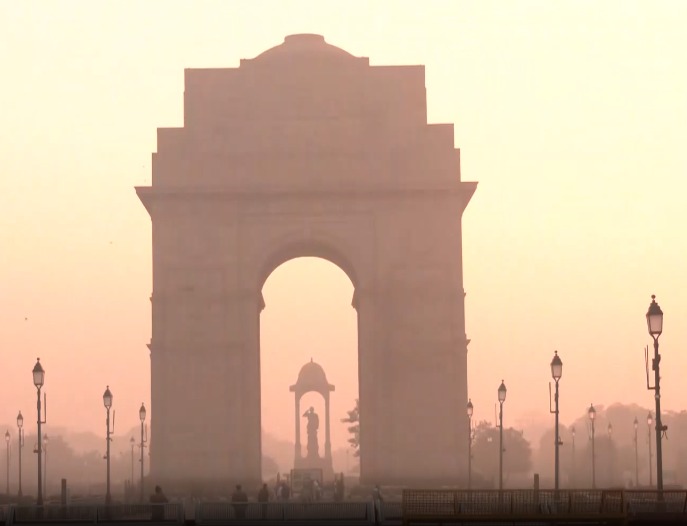
New Delhi, Feb 5: Delhiites began Thursday morning with air quality in the ‘poor’ category, even as the India Meteorological Department (IMD) predicted a clear sky along with shallow fog.
As per the Central Pollution Control Board (CPCB), the national Capital’s average Air Quality Index (AQI) stood at 279 at 6:00 am. The reading showed a noticeable improvement from Wednesday, when the city’s air quality was recorded in the ‘very poor’ range with an average AQI of 339.
Among the various monitoring locations, Lodhi Road, Narela and Dilshad Garden registered the best air quality levels on Thursday. These stations recorded AQI readings in the ‘moderate’ category. Data from 39 monitoring stations across Delhi showed that 18 stations remained in the ‘very poor’ range, while the rest reported ‘poor’ air quality.
Several parts of the city continued to experience ‘very poor’ pollution levels. Anand Vihar recorded an AQI of 332, Bawana stood at 306, and Ashok Vihar registered 320. Other areas with similarly high pollution levels included Dwarka Sector 8 (328), RK Puram (314), Rohini (322) and Patparganj (307), according to CPCB data.
At the same time, some pockets of the capital witnessed comparatively better air quality. Aya Nagar recorded an AQI of 214, while Chandni Chowk stood at 218. Sonia Vihar also showed improvement with an AQI of 299, though these readings still remained within the ‘poor’ category.
DTU also recorded ‘poor’ air quality with an AQI of 264. Other locations such as Mandir Marg (214), Najafgarh (258) and CRRI Mathura Road (226) reported similar pollution levels, remaining in the ‘poor’ range.
Narela, however, performed better than many other parts of Delhi, recording an AQI of 195 and entering the ‘moderate’ category, as per CPCB figures.
Under the AQI classification system, readings between 0 and 50 are considered ‘good’, 51 to 100 ‘satisfactory’, 101 to 200 ‘moderate’, 201 to 300 ‘poor’, 301 to 400 ‘very poor’ and 401 to 500 ‘severe’.
The CPCB had reported on Wednesday that the overall air quality in Delhi was in the ‘very poor’ range, with the city’s average AQI recorded at 339.
Looking ahead, the IMD has forecast partly cloudy skies along with shallow fog during morning hours over the next five days. No weather alert has been issued for Delhi during this period.
From February 8, moderate fog is expected to return. The weather department has not released any warning for the coming days. Temperatures are likely to remain largely stable, with maximum temperatures expected to stay between 22 degree Celsius and 24 degree Celsius, while minimum temperatures may range from 8 degree Celsius to 11 degree Celsius.
Meanwhile, the New Delhi Municipal Council (NDMC) announced on Wednesday that Kaka Nagar has become the first residential colony to adopt a fully mechanised and dust-free cleaning system. NDMC Chairman Keshav Chandra said the initiative is aimed at improving air quality and promoting sustainable sanitation practices in urban areas.
Across northern India, cold wave conditions and fog continued on Thursday, with the IMD issuing warnings of dense to very dense fog in several states during morning and night hours. The persistent fog has been accompanied by a sharp drop in temperatures, especially across the Indo-Gangetic plains, where minimum temperatures have fallen by 2 to 3 degrees Celsius below normal.
According to the IMD, dense fog is very likely at isolated places in Uttar Pradesh. Dense fog is also expected over Bihar, Himachal Pradesh, Uttarakhand and West Madhya Pradesh. In Uttarakhand, the IMD has flagged the possibility of ground frost at multiple locations, which may affect crops and also create difficulties for early morning commuters.
The IMD further stated that minimum temperatures across northwest India are unlikely to witness any major change in the next few days. However, Uttar Pradesh may see a gradual fall of 2 to 3 degrees Celsius. In central and eastern parts of the country, night temperatures are expected to decline over the next 48 to 72 hours before settling.
Under the influence of an active western disturbance, isolated to scattered rainfall and snowfall is likely over Jammu & Kashmir, Ladakh, Himachal Pradesh and Uttarakhand on February 5 and 6. The IMD has issued yellow alerts for these regions, advising caution due to slippery roads and reduced visibility in higher altitude areas.