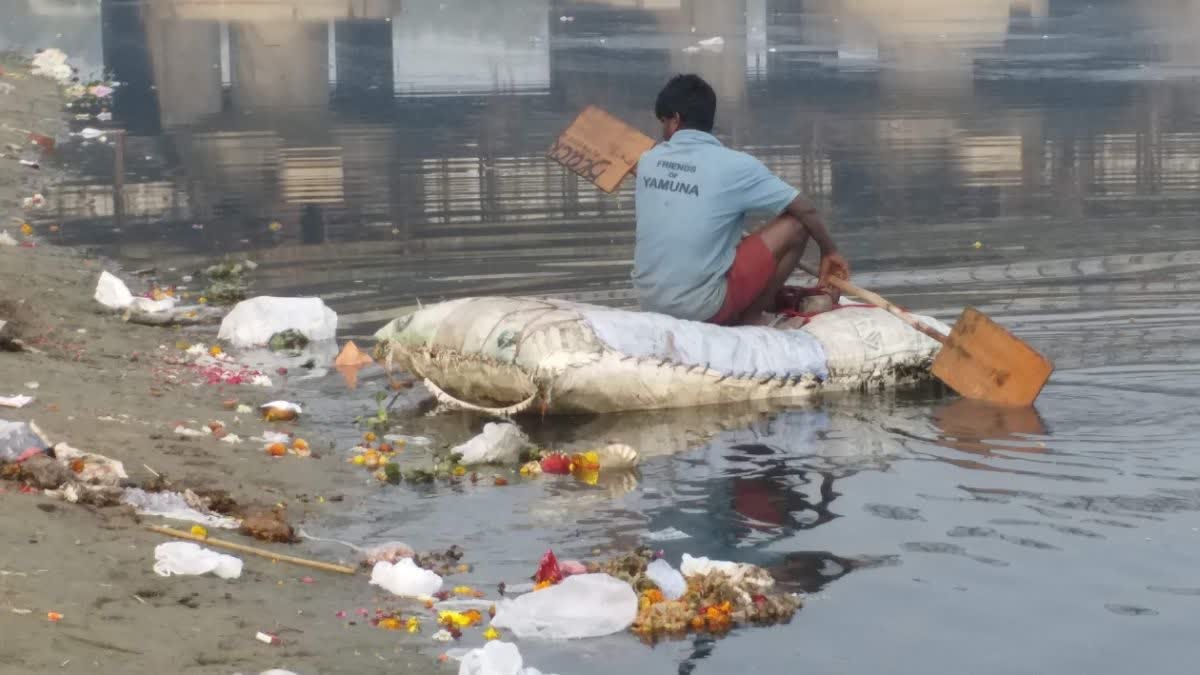
New Delhi: Often called Delhi’s lifeline, the Yamuna is battling for survival. A river that once flowed clear and ceaselessly has now become synonymous with foul odour, toxic foam, and black, viscous water. Every year on June 5, as we observe ‘World Environment Day’, India’s capital bears witness to a dire water crisis and the looming erasure of its life-sustaining river.
The scorching summer of 2026 has been an extraordinary season for Delhi. Intense heat and reduced snowfall in the Himalayas have reduced the Yamuna — one of the country’s most important rivers — into a narrow, murky stream. It is so critical that the water level at Delhi’s Wazirabad Barrage has plummeted to near-historic lows, sparking a desperate outcry for water across the city.
In the last week of May 2026, Yamuna’s water level at Wazirabad Barrage dropped to 668.5 ft — 6 ft below the normal (674.5 ft), and dangerously close to the all-time low of 667 ft recorded on July 16, 2021. Very little water remains in the pondage areas of the Wazirabad and Chandrawal water treatment plants (WTPs). To manage the situation, efforts are being made to draw water from deeper sections of the riverbed by digging channels. But this water contains high levels of silt.
However, the Yamuna transforms during the monsoons every year. Last September, the water level reached 207.4 m at the Old Railway Bridge, causing the third-worst flood in Delhi’s history, inundating large parts of Delhi next to the river.
Typically, the Delhi Jal Board (DJB) supplies 1,000 million gallons per day (MGD) of water through its nine WTPs, but the current crisis has severely disrupted the drinking water supply. The Wazirabad plant (capacity 110 MGD) is operating at only 65 per cent of its capacity, while the Chandrawal plant (capacity 90 MGD) is running at just 80-85 per cent capacity.
To keep these plants operational, over 100 MGD of water had to be diverted from the Haiderpur WTP, resulting in a 10 per cent reduction in water pressure in other parts of Delhi. Drinking water supply in New Delhi Municipal Council (NDMC) areas has dropped by 14-15 per cent to around 125 MLD (million litres per day), against a demand of 148 MLD.
Meanwhile, areas like Model Town, Shadipur, Tilak Nagar, Patel Nagar, Rajendra Nagar, Narela, Deoli, and Dakshinpuri are facing a severe water crisis. In many localities like Kalyanpuri, water supply lasts barely 15 minutes, forcing residents to rely on tanker water even for drinking and washing dishes.
Environmental expert Anil Kumar Gupta, a board member of both the Central Pollution Control Board (CPCB) and the Delhi Pollution Control Committee (DPCC), expressed deep concern over the dismal state of the Yamuna, and Delhi’s water crisis. Noting that the Yamuna is Delhi’s primary drinking water source, he said that when the Upper Yamuna River Treaty was signed 20-25 years ago, the capital’s population was under 10 million. But today, it has crossed the 30-million mark. Yet, Delhi continues to receive the same old allocation of 1,000 cusec (cubic foot per second) of water.
Gupta added that given Delhi’s growing population, the treaty should be revised and Delhi’s share increased. He further said that the Yamuna bed should be dredged and desilted to increase its water-holding capacity, so that monsoon water can be retained and used during summer.