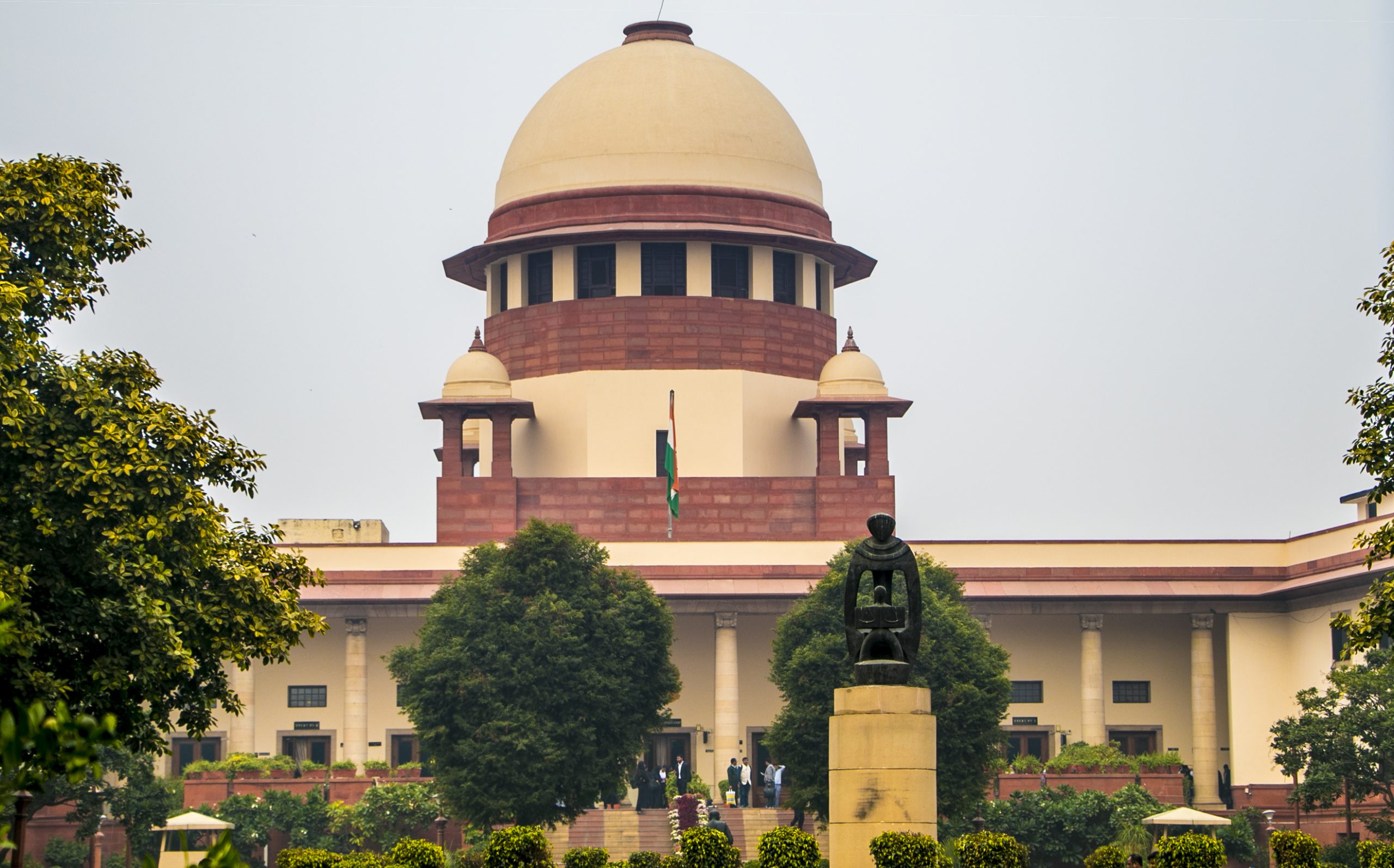
New Delhi, Jan 13 (UNI) The Supreme Court on Tuesday delivered a split verdict on the constitutional validity of Section 17A of the Prevention of Corruption Act, which requires prior government approval before starting an investigation against a public servant for decisions taken in official duty.
A two-judge Bench comprising Justice B.V. Nagarathna and Justice K.V. Viswanathan differed in their views on the provision, which was inserted through the 2018 amendment to the Act.
Due to the difference of opinion, the matter has been referred to the Chief Justice of India for constituting an appropriate Bench to finally decide the issue.
Justice Nagarathna held that Section 17A is unconstitutional and should be struck down. She observed that the provision tends to shield corrupt officials instead of protecting honest officers.
According to her, the requirement of prior approval blocks inquiry at the very beginning and goes against the purpose of the anti-corruption law. She noted that similar protections had earlier been struck down by the Supreme Court in the Vineet Narain and Subramanian Swamy cases, and Section 17A was an attempt to revive those invalid provisions.
On the other hand, Justice K.V. Viswanathan upheld the validity of Section 17A but gave it a limited interpretation. He ruled that the decision on granting sanction should not rest with the government or the executive, but must be taken by an independent body such as the Lokpal at the Centre or the Lokayukta in the States. To this extent, he “read down” the provision.
Justice Viswanathan observed that striking down the law entirely could expose honest public servants to frivolous and malicious complaints, leading to policy paralysis.
He said a balance must be maintained between protecting honest decision-making and ensuring accountability in public office. He added that the possibility of misuse is not, by itself, a valid reason to invalidate a law.
The judgment arose from a writ petition filed by the Centre for Public Interest Litigation (CPIL), which challenged the constitutional validity of the 2018 amendments to the Prevention of Corruption Act, particularly Section 17A.
The judgment had been reserved on August 6, 2025.
Section 17A bars any police officer from initiating an enquiry, inquiry, or investigation against a public servant for actions taken in discharge of official duties without prior approval from the competent authority of the Central or State Government.
An exception is made in cases where a public servant is caught red-handed while accepting a bribe.
The provision also requires the authority to decide on approval within three months, extendable by one more month with reasons.
Advocate Prashant Bhushan, appearing for the petitioner, argued that the provision reintroduced executive control over investigations, which had already been declared unconstitutional by the Supreme Court in earlier rulings.
He contended that allowing the executive to decide whether an investigation should begin creates a clear conflict of interest, especially when ministers themselves may be involved in the decisions under scrutiny.
Representing the union government, Solicitor General Tushar Mehta defended the provision, stating that earlier judgments did not prohibit all forms of prior approval.
He argued that Section 17A is narrowly framed to protect bona fide official decisions and prevent harassment of honest officers through baseless complaints. He maintained that safeguards are necessary to ensure fearless and effective governance.
With the split verdict, the final word on the validity of Section 17A will now be decided by a larger Bench of the Supreme Court.
UNI SNG VAN AAB