By Venkatachari Jagannathan
Andhra Pradesh, Jan 13 (UNI) Is the Indian space agency’s workhorse rocket Polar Satellite Launch Vehicle (PSLV) has turned a lame horse or the rocket is now the ISRO’s wild boy?
These queries now arise owing to the regular failure of the PSLV rocket in the case of India’s costly strategic missions.
Indian space agency officials used to term the Geosynchronous Satellite Launch Vehicle (GSLV) as the naughty boy owing to its failure rates.
Now it seems, the PSLV rocket is turning wild with repeated failures in a short span of time.
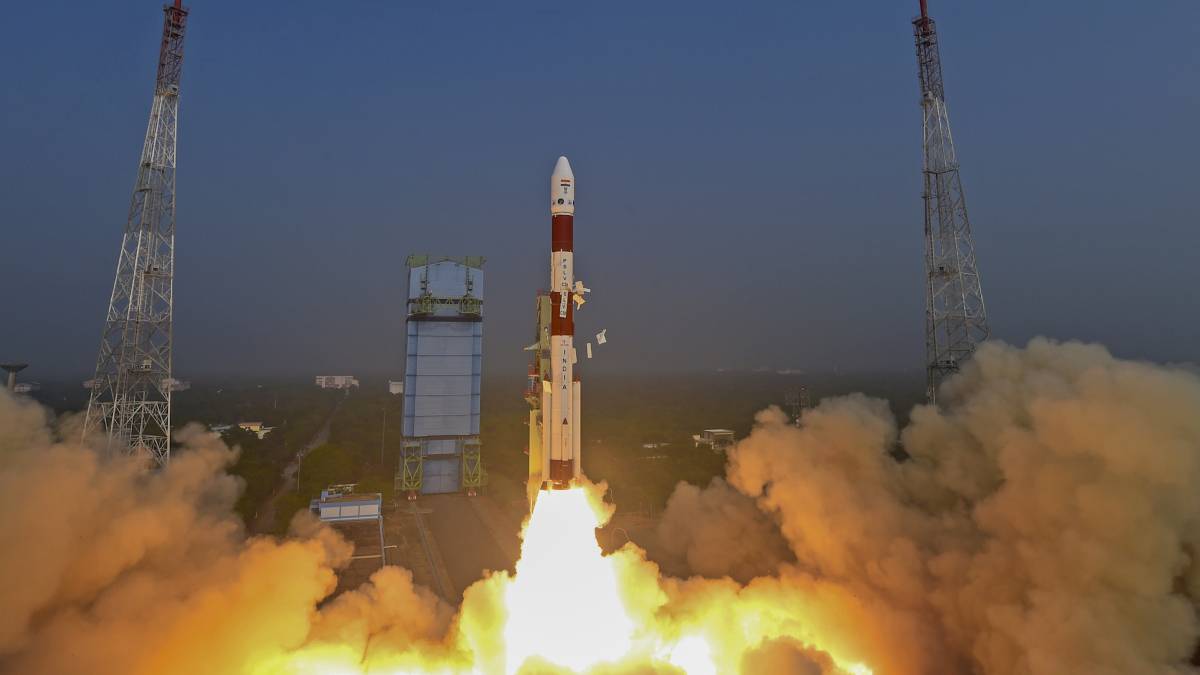
The latest failure was on Monday morning when the DL variant of the PSLV rocket coded PSLV-C62 that was carrying India’s latest strategic satellite Anvesha or EOS-N1 failed midway.
The rocket went off the path and tumbled when its third stage powered by solid fuel seems to have been cut off.
Speaking about the mission, Secretary, Department of Space and Chairman, Indian Space Research Organisation (ISRO) Dr.V. Narayanan said the rocket experienced disturbance towards the end of the third stage performance. The first two stages performed normally.
Subsequently, towards the end of the third stage burn, there was a deviation in the rocket’s flight path, Narayanan said. According to him, ISRO will come back after analysing the data generated by various ground stations.
Narayanan `ran’ away from the media centre without taking any questions, unlike his predecessors who used to answer the media when a space flight fails.
Action Replay by PSLV
The Jan 12, 2026 rocketing was an action replay of an earlier PSLV-C61 rocket that flew in May 2025. “The failure of PSLV-C62 seems to be similar to that of its predecessor PSLV-C61,” a rocket expert not wanting to be quoted told this correspondent.
In May last year the XL variant of PSLV – designated as PSLV-C61- lifted off with 1,696.24 kg earth observation satellite or RISAT-1B (radar imaging satellite with synthetic aperture radar), and after six minutes into its flight, soon after the solid fuel third stage was ignited, the vehicle veered off the path.
Even then Narayanan said the first two stages of the rocket performed as expected and during the third stage performance, there was an “observation” and the EOS-09 mission could not be accomplished.
He also told the journalists that there was a fall in the third-stage chamber pressure in the motor case. What was the “observation” that ISRO Chairman and the space agency did not explain.
A former senior official of ISRO said the failure of the third stage could be due to a faulty valve-main or some other redundant component that resulted in the fall in the chamber pressure.
This is the third consecutive failure of a mission that was to serve India’s strategic interests. In January 2025, the 2,250 kg navigation satellite NVS-02 that was placed in the Geosynchronous Transfer Orbit (GTO) got stuck there as its pyro valve did not open to pump in the oxidiser to fire the motors while the fuel pumps were working.
One of the probable reasons for the pyro valve of NVS-02 not opening could be a fault with the electrical connector. However, it is still unknown as to the actual reason for the pyro valve’s failure.
The report of the Failure Analysis Committee set up by ISRO to study the NVS-02 failure has not been made public till date–again at variance to the space agency’s earlier practice.
PSLV’s regular failure a cause for concern:
The PSLV is a four staged rocket powered by solid and liquid propellants alternatively. The first and third stages are fired by solid propellant and the second and fourth stages are fired by liquid propellant.
The rocket that failed on Jan 12, 2026 was called PSLV-DL variant. But for four failures – first in 1993, second in August 2017 (heat shield did not separate and encapsulate the satellite) and the third one in May 2025 and the fourth one on Jan 12, 2026– the PSLV has an excellent success record launching several Indian and foreign satellites.
ISRO also had earlier dismantled a fully assembled PSLV rocket to check a component in the rocket’s second stage. The successive two failures of PSLV may slightly dent ISRO’s prospects in the global small and medium sized global satellite launch market.
Most of PSLV’s commercial luggage are small satellites piggybacking on Indian satellites. With the US based SpaceX offering attractive rates and also safe delivery in space, even Indian satellite makers may not prefer ISRO.
Already a couple of Indian small satellite players have ortbited their spacecraft through the SpaceX rocket. But the more serious issue on the hand is the successive failures of India’s satellite missions that were expected to serve the country’s strategic interests.
“Once it is an accident, twice it is a failure and the third time?! What could it be,” wondered a retired senior official of the Indian space agency. There is no fixation of accountability and responsibility when missions involving hundreds of crores of Indian tax payer’s money goes waste, the official added.
UNI VJ PPP KK
PSLV–The New Wild Boy of ISRO?